




Most software projects start with a timeline measured in months. This one started with a different question: what if we measured it in hours instead?
That question drove a real build at AvyaTech. The team took a complete property listing platform from a blank screen to a working application using AI-assisted tools, no-code platforms, and focused engineering judgment. The result is one of the clearest demonstrations of what an AI agency can actually do when AI is embedded in the work from the start — not added as an afterthought once the hard parts are done.
This article breaks down exactly how it was built, which tools made it possible, and what it means for founders and product teams thinking about how to build software in 2026.
What Was Built
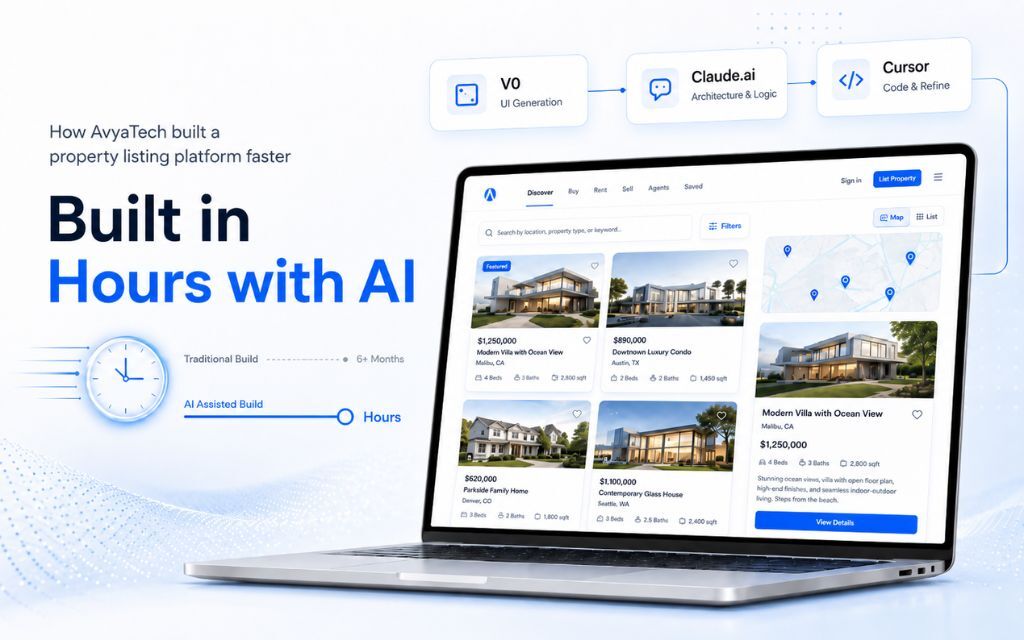
The deliverable was a functional property listing website. Not a mockup. Not a prototype with placeholder buttons. A working platform where users can browse listings, view property details, and interact with an interface that mirrors what you’d expect from a production-grade real estate application.
It was built using V0, Claude.ai, and Cursor — each handling a distinct layer of the build. That combination is what made the timeline possible.
The Tools That Made It Work
V0 for UI Scaffolding
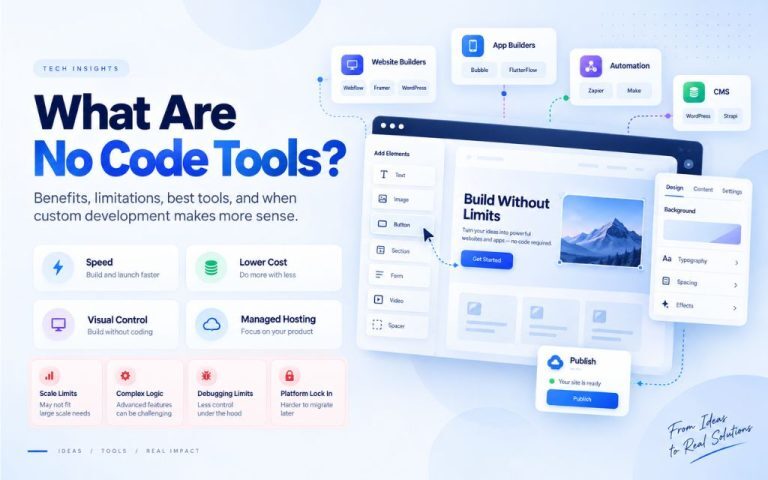
V0 is a no-code development platform that generates React-based UI components from natural language prompts. Instead of a designer spending days building screens from scratch, the team used V0 to produce the initial layout and component structure in a fraction of that time.
The output isn’t throwaway code either. V0 produces clean, editable React components that engineers can take directly into a real codebase — which removes the gap between design and development that traditionally adds weeks to a project.
Claude.ai for Logic and Architecture
Claude.ai handled the reasoning-heavy work: structuring the data model, drafting application logic, and thinking through edge cases before a single line of production code was written. Bringing an AI model into the architecture stage means fewer costly decisions are made late in the build.
Most agencies still rely entirely on human senior engineers working through these problems manually. Using Claude.ai at this stage compresses that time without removing the human judgment that validates the output.
Cursor for Code Generation and Review
Cursor is an AI-native code editor that generates, explains, and refactors code in context. The AvyaTech team used it to write and iterate on the actual application code. It also supports inline code review, so quality checks happen during development — not after the fact.
Cursor is the same tool AvyaTech uses alongside GitHub Copilot and Tabnine across its broader development work. What made this build different is that all three phases — UI generation, logic design, and code writing — were handled by AI-native tools working together, not in isolation.
Why This Matters for Founders and Product Teams
A property listing platform built in hours is a proof point, not a party trick. Here’s what it actually signals.
Speed is real, not theoretical. The traditional software development cycle runs 6 to 12 months for a project of this scope. AvyaTech’s AI-accelerated process targets 2 to 4 months for full production builds. This demo shows that certain scopes can move even faster when the right tools are applied with discipline.
Cost follows time. Fewer engineering hours mean lower cost — directly. AvyaTech’s headline figure is up to 70 percent cost reduction versus traditional agency pricing. A project that would run $100,000 at a conventional agency can come in around $30,000. The property listing build illustrates the mechanism behind that number.
AI tools still require engineering judgment. V0 generates components. Cursor writes code. Claude.ai reasons through architecture. None of them replaces the engineer who decides what to keep, what to refactor, and how the pieces fit together. That judgment is what AvyaTech brings. It’s also the difference between a demo and a deployable product.
How This Fits Into AvyaTech’s Broader Process
This build isn’t a one-off experiment. It reflects how AvyaTech approaches every project — from web and mobile development to cloud systems and custom AI integrations.
The full development lifecycle runs from discovery through solution design, development, QA with BrowserStack, and deployment. AI tooling is active at every stage. During planning, it helps scope work and surface ambiguity early. During coding, Cursor and GitHub Copilot accelerate output while keeping quality high. At the time of QA, automated testing workflows reduce the manual regression burden.
The result is a process that’s faster and more consistent than what most traditional agencies can offer — without cutting the quality layer that matters when software goes into production.
What to Ask When Evaluating an AI Agency
Most agencies calling themselves AI-native are using AI to write marketing copy or generate project summaries. That’s not the same as embedding AI tooling into the actual build process.
When you’re evaluating an AI agency in 2026, ask specific questions. Which tools are your engineers using daily? Can you show me something you built with them? How does AI tooling affect your QA process — not just your coding speed?
AvyaTech answers those questions with named tools, documented builds, and published case studies. The property listing platform is one example. The 44 East Ave real estate web application is another. The RAC Force AI-enabled customer service platform is another. The pattern across all of them is the same: AI tooling applied at every stage, with human engineers making the calls that determine whether the output is production-ready.
The Honest Limitations
Speed at this level applies to well-defined scopes. A property listing platform with clear requirements is a strong candidate for an AI-accelerated build. A complex enterprise system with legacy integrations, compliance requirements, and multi-stakeholder sign-off takes longer — even with AI tooling.
AvyaTech’s 2-to-4 month timeline applies to full production builds, not every conceivable project. Scope, complexity, and requirement clarity all affect delivery time. What changes with an AI-native process is the floor, not just the ceiling.
FAQs
An AI agency embeds AI tooling directly into its development process — using tools like Cursor, GitHub Copilot, and no-code platforms like V0 and Lovable.dev to accelerate coding, design, and QA. A traditional agency relies primarily on manual engineering at each stage. The practical difference shows up in speed and cost: AI-native agencies can deliver comparable output in less time and at lower cost.
AvyaTech built a functional property listing platform in hours using V0, Claude.ai, and Cursor. For a full production-ready version with custom features, integrations, and QA, timelines vary by scope. AvyaTech’s standard delivery window for projects of this type is 2 to 4 months, compared to the industry average of 6 to 12 months.
The build used three primary tools: V0 for UI component generation, Claude.ai for application logic and architecture, and Cursor for code generation and inline review. These sit within a broader toolkit that includes GitHub Copilot, Tabnine, and Amazon Q for coding, and BrowserStack for QA.
Yes — when AI tooling is paired with experienced engineering judgment and a dedicated QA layer. AvyaTech uses AI-led code reviews inside Cursor and runs testing through BrowserStack. The property listing platform and other published case studies reflect production-grade output, not prototype-quality demos.
AvyaTech doesn’t publish fixed pricing, but the documented cost comparison is $30,000 versus $100,000 for comparable output — up to 70 percent savings versus traditional agency rates. Actual project cost depends on scope, complexity, and engagement model. AvyaTech offers Fixed Price, Time and Material, and Dedicated Team options.
Projects with clear requirements and defined scope benefit most. MVPs, product redesigns, e-commerce platforms, real estate applications, and customer-facing web apps are strong candidates. Complex enterprise systems with heavy legacy integration can still benefit from AI tooling, but the time savings are more moderate.
The best starting point is a free AI consultation. AvyaTech covers the full development lifecycle from discovery through deployment, works with startups from $30,000 engagements and enterprises from $100,000 and above, and holds certifications in Laravel, AWS, and Adobe Commerce. Published case studies across real estate, e-commerce, IoT, and nonprofit sectors give you a concrete sense of the work.