




Most businesses asking about ChatGPT integration aren’t really asking a technical question. They’re asking a business question: will this actually work for us, how long will it take, and what will it cost?
Those are the right questions. Here’s what you need to know.
What “ChatGPT Integration” Actually Means
ChatGPT integration isn’t a single thing. The term covers a wide range of implementations, and the scope you choose determines both the cost and the complexity.
At the simplest end, you’re connecting OpenAI’s API to an existing product — adding a chat interface to your website or embedding an AI assistant into a support workflow. At the more complex end, you’re building a system where ChatGPT reasons over your proprietary data, takes actions inside your software, and operates as part of a larger AI agent pipeline.
The most common integration types businesses are pursuing in 2026:
- Customer support chatbots that handle tier-1 queries, escalate intelligently, and reduce ticket volume
- Internal knowledge assistants that let employees query company documentation, SOPs, or CRM data in plain language
- AI-powered content tools that help marketing, sales, or product teams draft, edit, or summarize content at speed
- Workflow automation agents that take multi-step actions — drafting emails, updating records, generating reports — triggered by user input
- Product-embedded AI features like smart search, recommendation engines, or contextual help inside a SaaS product
Each of these has a different build profile. A basic support chatbot might take three to four weeks. A full AI agent with access to your internal systems, memory, and tool-calling capabilities is a two-to-four month project at minimum.
The Core Technical Components
Understanding what goes into a ChatGPT integration helps you evaluate proposals and avoid scope surprises.
API Connection and Prompt Architecture
Every integration starts with connecting to OpenAI’s API and building the prompt logic that governs how the model behaves. This isn’t just “write a system prompt.” Good prompt engineering shapes the model’s tone, scope, and guardrails — it determines whether your AI assistant stays on topic or starts generating answers it shouldn’t.
This is a real skill. Weak prompt architecture is the most common reason ChatGPT integrations underperform once they’re live.
Retrieval-Augmented Generation (RAG)
If you want ChatGPT to answer questions based on your own data — product docs, knowledge base, customer records — you need a RAG layer. This means embedding your content into a vector database and retrieving relevant chunks at query time, so the model generates answers grounded in your actual information rather than general training data.
RAG is now standard for any serious business integration. It’s also where most of the backend engineering effort lives.
Authentication, Access Control, and Data Handling
Enterprise integrations require proper access control. Who can ask what? Can the AI access sensitive customer data? How is conversation history stored, and for how long? These questions need engineering answers before you go to production — not after.
Front-End Interface
The chat UI, input handling, streaming responses, error states — this is consistently underestimated. A production-quality interface takes real front-end work, especially when it needs to match your existing product’s design system.
Testing and Evaluation
AI systems need a different QA approach than traditional software. You’re not just checking for bugs — you’re evaluating response quality, edge case behavior, hallucination rates, and latency. Skipping this step is how businesses end up with AI features that embarrass them publicly.
What ChatGPT Integration Costs in 2026
Cost depends on scope. Here are realistic ranges based on the integration types above.
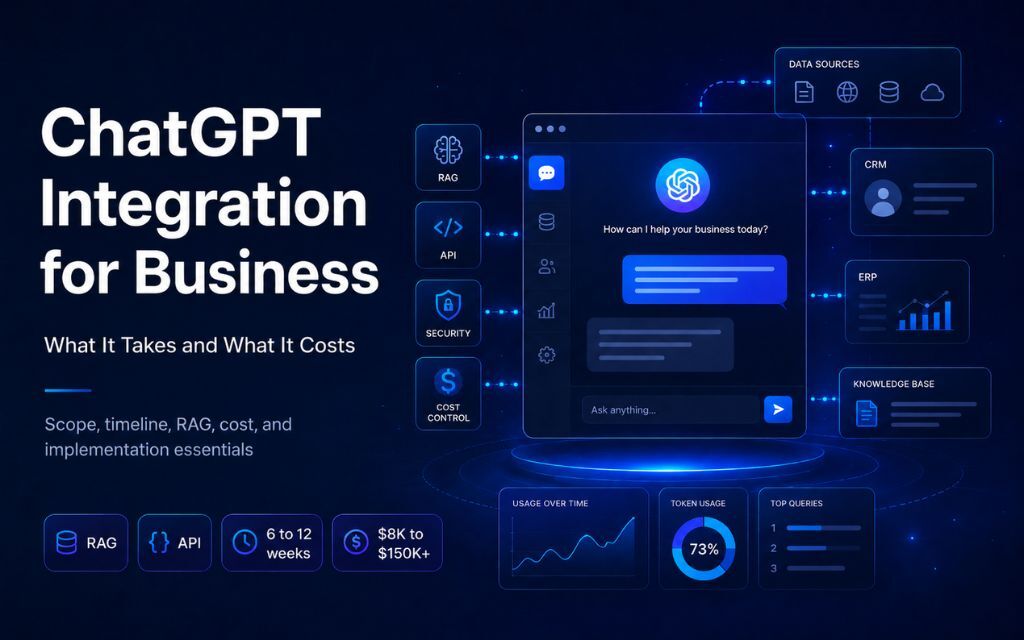
Basic chatbot or FAQ assistant: $8,000 to $20,000. Simple API connection, limited data sources, standard UI. Works well for a small business adding AI to a support page or lead capture flow.
Mid-tier integration with RAG and custom data: $20,000 to $50,000. Includes vector database setup, document ingestion pipeline, prompt engineering, and a polished interface. This is the most common project type for growth-stage startups.
Full AI agent with tool-calling and system integrations: $50,000 to $150,000 and above. Connects ChatGPT to internal APIs, CRM systems, databases, or third-party services. The model takes actions, not just answers questions. Requires significant backend architecture.
Ongoing API costs: Separate from build costs, you’ll pay OpenAI per token used. For a moderately active business application, expect $200 to $2,000 per month depending on volume and model selection.
One thing worth flagging: the difference between a $15,000 chatbot and a $50,000 one isn’t always obvious in a demo. It shows up in production — in how the system handles edge cases, how it scales, and how easy it is to update when your data changes.
What Takes the Longest
Timeline surprises usually come from three places.
Data preparation. If your knowledge base is scattered across PDFs, Google Docs, Notion pages, and a legacy CMS, cleaning and structuring that content for ingestion takes real time. This is often the longest part of a RAG project, and it’s almost always underestimated.
Stakeholder alignment on scope. “What should the AI be able to do?” sounds like a simple question. Getting everyone in your business to agree on the answer is not. Define this before development starts.
Security and compliance review. If you’re in healthcare, finance, or any regulated industry, your legal and security teams will have questions about data handling, model access, and audit trails. Build time for this into your project plan from the start.
A well-scoped ChatGPT integration with an experienced team typically takes six to twelve weeks from kickoff to production deployment. Rushed projects that skip the scoping phase often take longer, not shorter.
How to Evaluate a Development Partner
The market for ChatGPT integration services grew fast in 2024 and 2025. That means there are now a lot of teams claiming AI expertise who haven’t actually shipped production AI systems.
When evaluating a partner, ask for:
- Specific examples of ChatGPT or OpenAI integrations they’ve shipped, with details on the architecture used
- How they handle prompt versioning and evaluation — a team without a clear answer here hasn’t done this seriously
- What does their QA process look like for AI-specific failure modes
- Whether they’ve worked with RAG pipelines and which vector databases they’ve used
A partner who can name the tools — Cursor for AI-assisted coding, GitHub Copilot for development acceleration, specific vector stores for RAG — is more credible than one who speaks only in generalities.
At AvyaTech, ChatGPT integration is a named service with documented case studies behind it, including the RAC Force AI-enabled customer service platform. The team uses OpenAI’s Codex and ChatGPT in active development, alongside GitHub Copilot and Cursor throughout the build process. That combination typically brings integration projects in at two to four months — compared to the six-plus months a traditional agency would quote — and at significantly lower cost.
Build It Right the First Time
The businesses getting real ROI from ChatGPT integration in 2026 aren’t the ones who moved fastest. They’re the ones who scoped carefully, chose the right integration type for their actual problem, and worked with a team that understood both the AI layer and the software engineering underneath it.
A chatbot that confidently gives wrong answers costs more than not having one. A well-built AI assistant that handles 40 percent of your support volume pays for itself in months.
Get the scope right. Get the partner right. Then move fast.
Frequently Asked Questions
ChatGPT integration connects OpenAI’s ChatGPT API to your existing software, website, or internal tools. Depending on how it’s built, it can power customer support chatbots, internal knowledge assistants, AI-driven content tools, or autonomous workflow agents.
Costs range from roughly $8,000 for a basic chatbot to $150,000 or more for a full AI agent with system integrations. Mid-tier projects with RAG and custom data typically fall between $20,000 and $50,000. Ongoing OpenAI API usage adds $200 to $2,000 per month, depending on volume.
A well-scoped project with an experienced team takes six to twelve weeks from kickoff to production. Data preparation and stakeholder alignment on scope are the most common sources of delays.
RAG stands for Retrieval-Augmented Generation. It lets ChatGPT answer questions based on your own data — documents, databases, knowledge bases — rather than relying on general training data alone. If you want your AI to know your business, you need RAG.
Yes. ChatGPT can connect to CRMs, internal APIs, databases, and third-party services through tool-calling and custom API layers. The complexity and cost scale with how many systems you’re connecting and what actions the AI needs to take.
Customer support, e-commerce, SaaS products, healthcare (with appropriate compliance measures), real estate, and professional services all have strong use cases. Any business with high-volume repetitive queries or large internal knowledge bases is a good candidate.