




Most software projects don’t fail because of bad ideas. They fail because they take too long and cost too much. A 12-month build timeline is a runway killer for startups and a budget nightmare for growing businesses.
That’s the problem an AI software development agency is built to solve. And in 2026, the difference between agencies that genuinely use AI across the full development lifecycle and those that just mention it in their pitch deck is significant.
This article breaks down what to look for when choosing an AI development agency, how the build process actually changes when AI is embedded throughout, and how AvyaTech compresses 6–12 month timelines down to 2–4 months without cutting corners.
What “AI Software Development Agency” Actually Means in 2026
The term gets used loosely. Some agencies call themselves AI-native because they added a ChatGPT integration to one client project. That’s not the same thing.
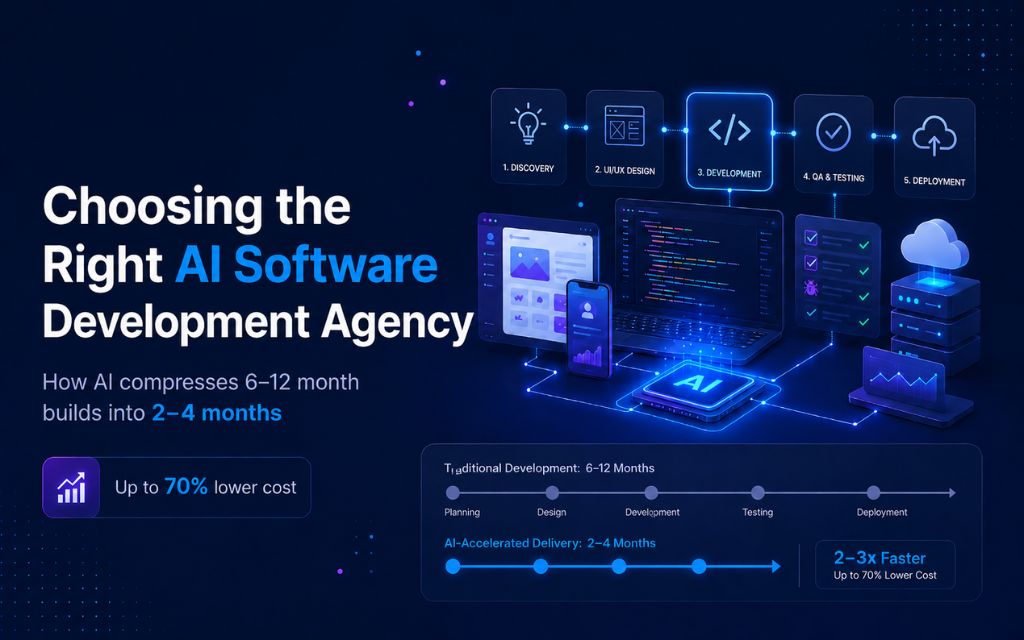
A genuine AI software development agency embeds AI tooling at every stage of the software development lifecycle (SDLC): discovery, UI/UX design, coding, QA, and deployment. The result is fewer manual hours, faster iteration cycles, and lower cost per deliverable.
The US custom software development market is projected at $65.85B in 2026. Demand is high, but most agencies still operate on traditional timelines and pricing. That gap is exactly where AI-accelerated development creates real value.
Where AI Actually Speeds Things Up
Here’s where AI tooling makes a measurable difference in a typical build:
- Planning and scoping: AI-assisted requirement analysis reduces discovery time from weeks to days
- UI/UX design: Tools like v0.app and Builder.io generate design scaffolding in hours, not weeks
- Coding: GitHub Copilot, Cursor, and Tabnine accelerate code generation and reduce repetitive boilerplate
- QA and testing: Automated test generation catches bugs earlier, reducing the back-and-forth that bloats timelines
- Deployment: AI-assisted DevOps tooling speeds up environment setup and CI/CD configuration
Each stage shaves time. Across a full project, the compounding effect is what takes a 10-month build and turns it into a 3-month one.
How AvyaTech Builds Software Differently
AvyaTech is an AI-accelerated development partner that covers the full stack: web apps, mobile apps, cloud systems, AI integrations, UI/UX, DevOps, and QA. The team uses AI tooling not as a feature to advertise, but as the actual method for building everything.
The core claim is direct: build timelines that traditionally run 6–12 months get compressed to 2–4 months, at up to 70% lower cost compared to traditional agencies.
The Full-Lifecycle AI Approach
Most agencies handle development in silos. AvyaTech’s model is end-to-end, with a single accountable team from discovery through deployment. AI tooling runs through every phase:
Discovery and planning: Scoping sessions use AI-assisted analysis to map requirements faster and identify risks earlier. You spend less time planning and more time building.
UI/UX design: The design team uses v0.app, Builder.io, and Lovable.dev to generate production-ready UI scaffolding quickly. You see real interfaces early, not wireframes that take three rounds of revision.
Development: Engineers work with GitHub Copilot, Cursor, Tabnine, and Amazon Q. The back-end stack is Laravel-certified; cloud infrastructure runs on AWS (AWS-certified); e-commerce builds use Adobe Commerce (Magento-certified). These aren’t just tools listed on a services page — they’re the active stack.
Generative AI integrations: If your product needs a custom LLM, an AI chatbot, ChatGPT integration, or prompt engineering, that’s a core capability, not a subcontracted add-on.
QA: Automated testing via BrowserStack runs alongside development, not after it. Bugs get caught earlier, which means fewer expensive fixes at the end.
Deployment: DevOps and deployment automation are handled in-house. You don’t need to manage a separate DevOps vendor.
Engagement Models: Pick What Fits Your Project
One reason buyers get burned by agencies is inflexible contracts. AvyaTech offers three engagement models:
| Model | Best For |
| Fixed Price | Well-defined scope, predictable budget, MVP builds |
| Time & Material | Evolving requirements, ongoing product development |
| Dedicated Team | Long-term builds, in-house team extension |
If you’re a startup with a clear MVP scope and a $30K–$80K budget, Fixed Price gives you cost certainty, you’re a mid-market company modernizing a legacy system with shifting requirements, Time & Materials gives you flexibility. If you need engineers embedded in your product team for 6–12 months, the Dedicated Team model works like an extension of your in-house capacity.
The entry point is a free AI consultation — a no-commitment conversation to scope your project and get a realistic timeline.
How AvyaTech Compares to Other AI Development Agencies in 2026
The market has no shortage of agencies claiming AI-first development. Here’s how the major players actually differ.
Intellectsoft
Intellectsoft has 17+ years of experience and Fortune 500 clients, including Intel and Luxottica. Their enterprise credibility is real. But their pricing and engagement model skews toward large enterprises — if you’re a startup or a $50K–$100K buyer, you’re unlikely to be their priority client. Pricing is not publicly disclosed, and their messaging doesn’t emphasize using AI to reduce client costs or build time.
TechAhead
TechAhead is one of the more genuinely AI-native agencies in the space, with capabilities in Agentic AI, RAG, and custom LLM development. They’ve shipped 2,500+ products and carry strong brand recognition. The challenge: their client roster (Audi, Disney, American Express) signals enterprise-scale deal sizes. Smaller teams often find the sales process and pricing out of reach. Rates are fully opaque.
Keyhole Software
Keyhole differentiates on talent quality — 100% US-based senior consultants averaging 17+ years of experience. That’s a strong proposition for risk-averse enterprise buyers. But the US-only staffing model implies premium rates, and there’s no explicit focus on using AI tooling to reduce build time or cost. For startups and SMBs needing lean, fast delivery, it’s likely not the right fit.
Where AvyaTech Fits
The gap all three leave open is the same: AI-accelerated delivery at startup-accessible pricing, with full-lifecycle ownership and transparent engagement. That’s the space AvyaTech operates in. You get agency-grade quality — certified on AWS, Laravel, and Adobe Commerce — without the enterprise overhead or opaque pricing games. The AI tooling isn’t a differentiator bolted on for marketing purposes. It’s how the team actually builds.
Who AvyaTech Is Built For
The primary fit is growth-stage startups (Seed through Series B) with 10–100 employees, a $30K–$150K development budget, and a founder, CTO, or VP of Product driving the decision. Common trigger points include:
- Launching an MVP before the runway runs out
- Replacing a slow or expensive existing development partner
- Raising a funding round and needing a product to show investors
The secondary fit is mid-market companies (100–500 employees) with IT Directors or Digital Transformation leads who need to modernize legacy systems or integrate AI into existing workflows. Budgets in this range typically run $100K–$500K+.
If you’re a non-technical founder who needs a single accountable partner from concept to deployment, the end-to-end model removes the coordination overhead that kills projects when you’re managing separate design, dev, and QA vendors.
What the 2–4 Month Timeline Actually Looks Like
A realistic AI-accelerated build for a mid-complexity web or mobile product breaks down roughly like this:
- Weeks 1–2: Discovery, requirements, technical architecture
- Weeks 3–5: UI/UX design, prototype review, sign-off
- Weeks 6–12: Core development with parallel QA
- Weeks 13–16: Integration, testing, deployment, handoff
That’s a 4-month timeline for a product that would take a traditional agency 9–12 months. The time savings come from AI-assisted design scaffolding, faster code generation, and QA running in parallel rather than sequentially.
For simpler MVPs, the timeline compresses further. For more complex systems, it scales — but the AI tooling keeps the ratio of output to time better than traditional methods.
Ready to Talk About Your Build?
If you’re comparing AI development agencies and want a direct conversation about your project scope, timeline, and budget, AvyaTech offers a free AI consultation as the starting point.
No enterprise sales process. No 3-week wait for a quote. Just a practical conversation about what you need and whether it’s a fit.
Frequently Asked Questions
An AI software development agency uses AI tooling across the full development lifecycle — planning, design, coding, QA, and deployment — to build software faster and at lower cost than traditional agencies. The key distinction is whether AI is embedded throughout the process or just used for one or two tasks.
AvyaTech’s AI-accelerated approach compresses typical 6–12-month build timelines down to 2–4 months. The exact timeline depends on project complexity, but the AI tooling in use at every stage — Cursor, GitHub Copilot, v0.app, and others — consistently reduces time compared to traditional development methods.
AvyaTech’s pricing is not publicly listed, but the team works with startups budgeting $30K–$150K and mid-market companies with $100K–$500K+ budgets. The AI-accelerated model is designed to deliver comparable output to traditional agencies at up to 70% lower cost. A free consultation is available to scope your specific project.
Three models: Fixed Price (best for defined-scope projects), Time and Materials (best for evolving requirements), and Dedicated Team (best for long-term builds or in-house team extension). You choose the model that fits how your team works.
Intellectsoft and TechAhead both have strong enterprise credentials and AI capabilities, but their pricing and sales processes skew toward large enterprise clients. AvyaTech targets the gap: AI-accelerated delivery with full-lifecycle ownership at pricing accessible to startups and mid-market businesses, with more transparent engagement models
The stack includes Laravel (certified) for back-end, AWS (certified) for cloud, Adobe Commerce/Magento (certified) for e-commerce, and modern JS frameworks for front-end. AI tooling includes GitHub Copilot, Cursor, Tabnine, and Amazon Q for development, plus OpenAI, Google Gemini, and a range of generative AI platforms for AI-native product features.
AvyaTech covers the full lifecycle: discovery, UI/UX design, development, QA (using BrowserStack and automated testing), and deployment. You work with one team from start to finish rather than coordinating multiple vendors.