




Autonomous agents are no longer a research concept. In 2026, businesses across industries are deploying AI agents that plan multi-step tasks, call external tools, make decisions, and execute workflows with minimal human input. The shift from simple chatbots to genuinely autonomous systems is happening fast — and the gap between companies that understand this and those that don’t is widening.
This article breaks down what AI agent development actually involves, where autonomous agents are creating real operational value, and what your team needs to think through before building one.
What Makes an AI Agent Different from a Chatbot
A chatbot responds. An AI agent acts.
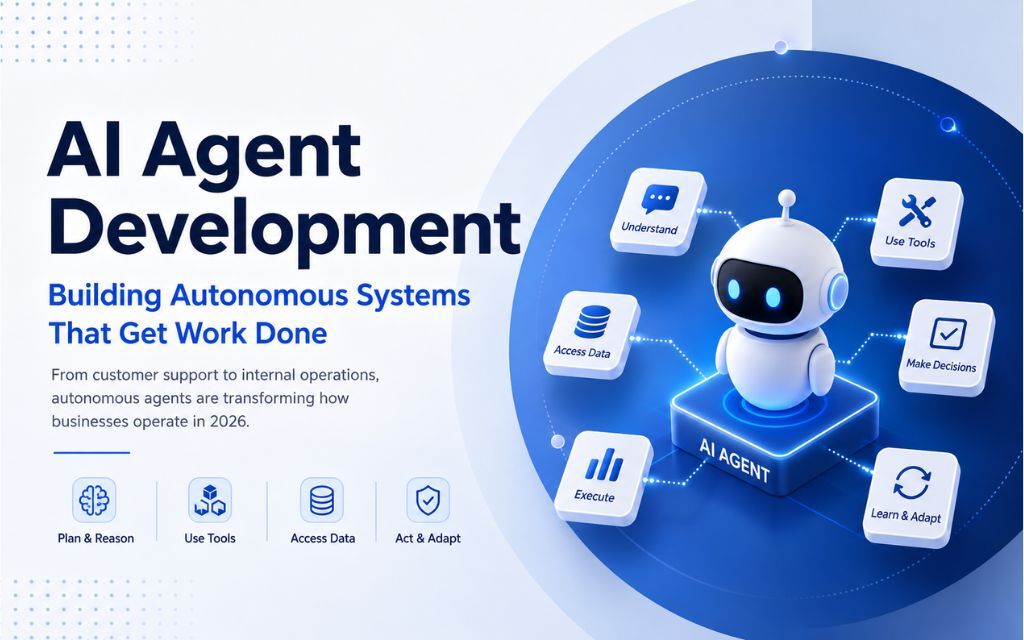
That distinction matters more than it sounds. A chatbot takes input and returns output. An AI agent takes a goal, breaks it into steps, decides which tools to call, executes those steps in sequence, evaluates the results, and adjusts if something fails. It operates in a loop, not a single exchange.
Technically, agents are built on top of large language models but extended with memory, tool access, and orchestration logic. A customer service agent might query a CRM, draft a reply, check a policy document, and escalate a ticket — all without a human touching it.
That capability is what makes AI agent development a fundamentally different engineering challenge than building a standard chatbot or a basic LLM integration.
How Autonomous Agents Are Reshaping Business Workflows in 2026
Customer Operations
Customer service is the most visible deployment area. Agents handle tier-1 support queries end to end — pulling from knowledge bases, checking order status via API, processing refunds within defined rules, and routing complex issues to human agents with full context already attached.
The result isn’t just faster response times. It’s a meaningful reduction in the volume of work that reaches human agents at all. Teams that previously needed 20 support staff to handle a given ticket volume are running leaner, with people focused on genuinely complex cases rather than routine ones.
Sales and Lead Qualification
Sales teams are using agents to qualify inbound leads, run initial outreach sequences, schedule discovery calls, and update CRM records automatically. The agent monitors signals, decides when a lead is warm enough to escalate, and hands off with a full activity log attached.
This compresses the sales cycle. A lead that might have sat in a queue for 48 hours now gets a response within minutes and a follow-up within the hour.
Internal Operations and Knowledge Work
Agents are also being deployed inside organizations for document summarization, contract review, report generation, and data extraction from unstructured sources. An operations team can point an agent at a folder of supplier invoices and get a structured summary with anomalies flagged — no SQL required.
For startups with lean teams, this is particularly valuable. You get the output of a larger team without the headcount.
Software Development Workflows
AI agent development is even reshaping how software itself gets built. Coding agents built on tools like GitHub Copilot, Cursor, and Amazon Q now handle code generation, test writing, code review, and documentation as part of an automated pipeline. At AvyaTech, these tools are embedded across the full development lifecycle — which is a core reason build timelines compress from 6–12 months down to 2–4 months.
The Core Components of an AI Agent
Understanding the architecture helps you ask better questions when evaluating a build.
LLM backbone: The reasoning engine. GPT-4o, Gemini, Claude, or a fine-tuned open-source model — the right choice depends on your use case and data sensitivity requirements.
Memory: Short-term memory handles context within a session. Long-term memory uses vector databases to retrieve relevant information across sessions. Without memory, an agent can’t learn from prior interactions.
Tool access: Agents call APIs, query databases, run code, search the web, or interact with other software systems. The tools available define what the agent can actually do.
Orchestration layer: This is the logic that decides which tools to use, in what order, and how to handle failures. Frameworks like LangChain, LlamaIndex, and AutoGen are commonly used here, though custom orchestration is often necessary for production-grade systems.
Guardrails and evaluation: Agents need constraints. Without them, they can take unintended actions, hallucinate facts, or loop indefinitely. Guardrails define what the agent is allowed to do; evaluation pipelines measure whether it’s doing it correctly.
What Makes AI Agent Development Hard
Building a demo is straightforward. Building a production agent that performs reliably is not.
The most common failure points:
- Tool reliability: If an external API returns an unexpected response, the agent needs to handle it gracefully — not fail silently or loop.
- Prompt brittleness: Small changes in how a task is described can produce dramatically different agent behavior. Prompt engineering for agents is more complex than for single-turn interactions.
- Hallucination in action: An agent that hallucinates a fact in a chatbot is annoying. An agent that hallucinates a fact and then acts on it — updating a database, sending an email — is a real operational risk.
- Observability: You need to see what the agent did, why, and where it went wrong. Without logging and tracing built into the architecture from the start, debugging becomes a serious problem.
- Cost control: Multi-step reasoning loops can consume significant token budgets. Without cost guardrails, a single runaway process can generate unexpected API bills fast.
These are engineering problems, not prompt problems. They require proper system design, not just a wrapper around an LLM.
Build vs. Buy: What to Consider in 2026
Off-the-shelf agent platforms exist, and for simple use cases, they work. But most businesses hit a ceiling quickly.
Generic platforms struggle when you need the agent to integrate deeply with your existing systems, follow your specific business logic, or operate within your security and compliance requirements. A customer service agent for a financial services firm has very different constraints than one for an e-commerce store.
Custom AI agent development gives you control over the architecture, the data, the guardrails, and the integration points. It costs more upfront but produces a system that actually fits your workflow — rather than forcing your workflow to fit the platform.
The right answer depends on your use case complexity, your data sensitivity requirements, and how much of your competitive advantage depends on the agent performing in a way a generic tool simply can’t replicate.
What to Look for in an AI Agent Development Partner
When evaluating partners for AI agent development, the questions that matter most are:
- Do they build with production-grade orchestration, or do they demo with LangChain and call it done?
- Can they show you how they handle agent failures, hallucinations, and cost control?
- Do they have experience integrating agents with existing systems — not just standalone deployments?
- What does their QA process look like for non-deterministic systems?
At AvyaTech, AI agent and chatbot development is a named service. The tooling behind it includes OpenAI’s Codex and GPT models, Google Gemini, and custom NLP pipelines built with Python, spaCy, and NLTK. QA runs through BrowserStack. The goal is always a production-ready system — not a proof of concept that stalls before deployment.
If you’re exploring what an AI agent could do for your specific workflow, talking to the team at AvyaTech is a practical starting point.
The Workflow Categories Where Agents Deliver the Most Value
Here are the workflow types where AI agents consistently deliver measurable returns in 2026:
| Workflow Type | What the Agent Does | Primary Benefit |
| Customer support | Resolves tier-1 tickets end to end | Reduced support headcount |
| Lead qualification | Scores, routes, and follows up on inbound leads | Faster sales cycle |
| Data extraction | Pulls structured data from unstructured documents | Hours saved per week |
| Internal reporting | Generates summaries and flags anomalies | Faster decision-making |
| Code review | Reviews PRs, flags issues, suggests fixes | Shorter development cycles |
| Onboarding | Guides new users through setup steps | Reduced churn in early stages |
The common thread: these are all repetitive, rule-bounded tasks that previously required human attention at every step. Agents handle the routine. Humans handle the exceptions.
FAQs
AI agent development is the process of building autonomous software systems that can plan, reason, and execute multi-step tasks using LLMs, memory, and external tools. Unlike chatbots that respond to single queries, agents operate in a loop — making decisions and taking actions to complete a defined goal.
A chatbot handles one-turn interactions: you ask, it answers. An AI agent takes a goal, breaks it into steps, calls tools or APIs as needed, evaluates results, and adjusts its approach. It can complete tasks across multiple systems without human input at each step.
Customer service, sales, finance, legal, healthcare operations, software development, and internal knowledge management are all active deployment areas. Any industry with high-volume, rule-bounded workflows is a candidate.
Cost depends on complexity, the number of integrations required, and the guardrails and evaluation infrastructure needed. Simple agents cost a fraction of what complex, production-grade systems do. Custom development through a partner like AvyaTech typically starts at $30,000 for scoped engagements.
A well-scoped agent with clear integrations and defined guardrails can go from discovery to deployment in 2 to 4 months with an AI-accelerated development process. Traditional timelines for comparable custom software run 6 to 12 months.
Hallucination in action, tool failures, runaway costs from looping processes, and poor observability are the most common production risks. Addressing them requires proper system design — not just prompt engineering.
Not necessarily. End-to-end development partners handle discovery, design, build, QA, and deployment. Non-technical founders and lean product teams work with agencies to deploy agents without any in-house engineering capacity.