




Most software projects still run the same way they did a decade ago. Engineers write code line by line, QA cycles drag on for weeks, and by the time you ship, the budget is blown and the timeline has doubled. The US custom software development market is projected at $65.85 billion in 2026 — and the majority of that spend still flows into slow, expensive, traditional delivery.
AI tech services are changing that equation. Not in a vague, theoretical way, but through specific tools embedded at every stage of the build process that cut time and cost in ways that are now measurable and repeatable.
Here’s exactly how AI-powered development delivers up to 70% cost reduction, what the mechanics look like, and what to watch for when choosing a partner.
What “AI Tech Services” Actually Means in 2026
The term gets used loosely. Some agencies put “AI-powered” on their homepage and mean they use ChatGPT to write blog posts. That’s not what we’re talking about.
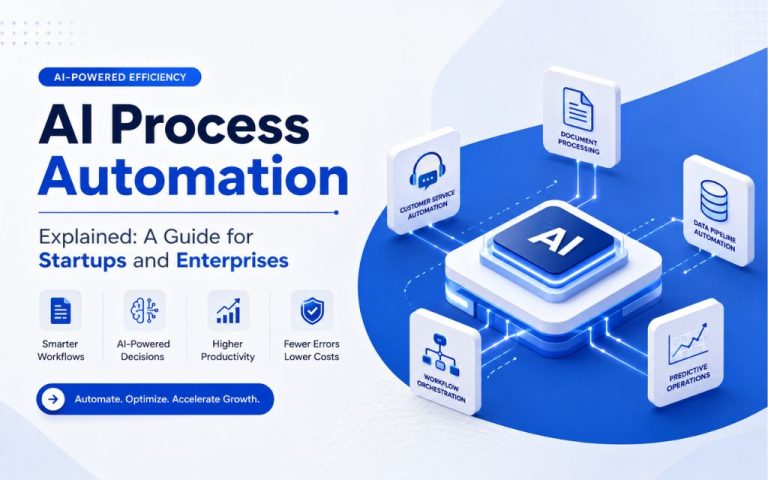
Genuine AI tech services means AI tooling is embedded across the full software development lifecycle — planning, design, coding, testing, and deployment. Every stage runs faster and with fewer errors because AI handles the repetitive, time-consuming work that used to eat engineer hours.
Here’s what that looks like in practice:
- Planning and scoping: AI assists with requirement analysis, user story generation, and architecture decisions — cutting discovery from weeks to days.
- UI/UX design: Tools like v0.app and Builder.io generate interface components from prompts, compressing design iteration cycles.
- Coding: GitHub Copilot, Cursor, Tabnine, and Amazon Q write and autocomplete code in real time. Engineers spend more time reviewing and directing, less time typing.
- Testing and QA: AI-assisted test generation combined with BrowserStack catches bugs earlier and reduces manual QA hours significantly.
- Deployment: Automated pipelines and AI-assisted DevOps shrink the gap between a working build and a live product.
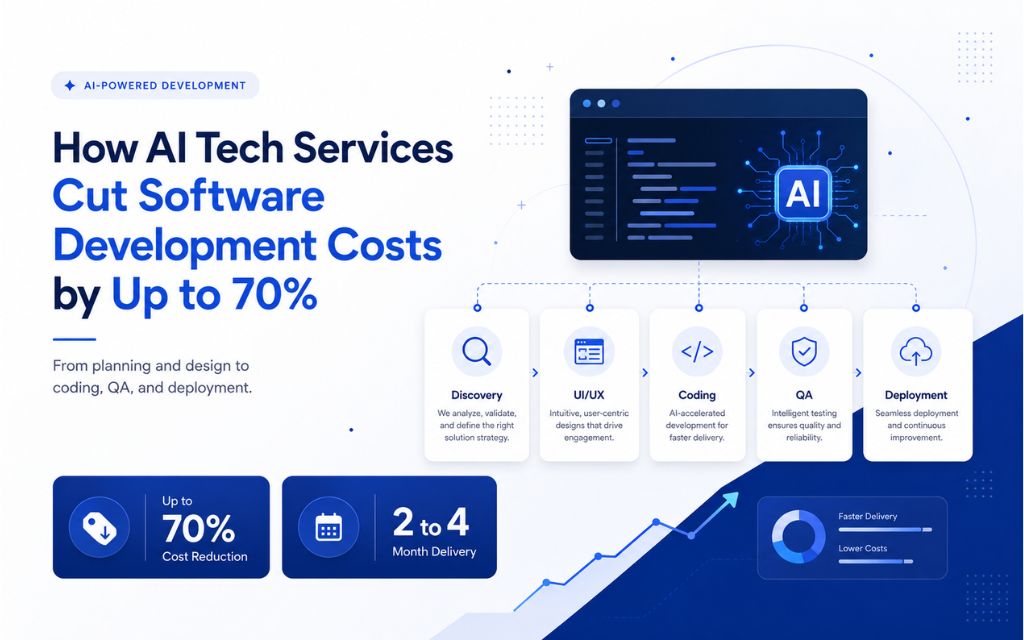
When all of this runs together, a project that would take 9 to 12 months the traditional way ships in 2 to 4 months. That’s the compounding effect of removing manual bottlenecks at each stage — not a marketing claim.
Where the 70% Cost Reduction Actually Comes From
The savings are real, but they come from specific places. Understanding the breakdown helps you evaluate whether a given agency is actually delivering them.
Reduced Engineering Hours Per Feature
AI code generation tools like Cursor and GitHub Copilot write boilerplate, suggest implementations, and autocomplete complex functions. Engineers still review and direct the output, but hours per feature drop substantially. Fewer hours billed means a lower invoice.
Faster QA Cycles
Manual QA is one of the biggest hidden cost drivers in traditional development. AI-assisted test generation creates test cases automatically from code and requirements. Paired with automated cross-browser testing through BrowserStack, your team catches issues faster and spends fewer cycles on regression testing.
Shorter Discovery and Design Phases
Discovery and UI/UX design typically account for 15 to 25% of a project budget. When AI tools accelerate wireframing, component generation, and requirement documentation, that phase compresses without cutting corners.
No-Code Where It Makes Sense
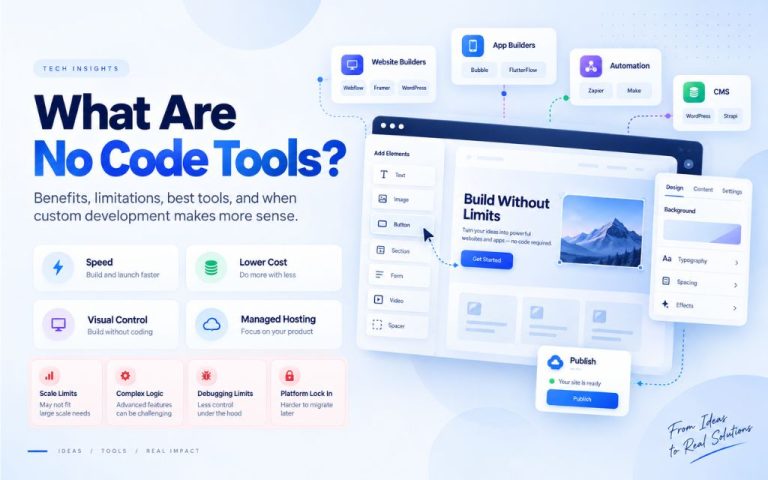
Not every part of your product needs custom-coded infrastructure. Platforms like Lovable.dev, Replit, and Base44 handle standard functionality quickly, freeing engineers for the work that genuinely requires custom development. You pay for custom engineering only where it adds real value.
Together, these savings explain how a project that would cost $100,000 at a traditional agency can come in at $30,000 with an AI-native team. That’s not a discount — it’s a fundamentally different cost structure.
The Full Lifecycle Matters More Than Any Single Tool
A common mistake is evaluating AI tech services tool by tool rather than looking at the full delivery model. A team that uses GitHub Copilot for coding but runs manual QA and a slow design process won’t deliver the same savings as one where AI is embedded at every stage.
The full lifecycle looks like this:
- Discovery — AI-assisted requirements gathering and architecture planning
- UI/UX Design — Generative tools for rapid prototyping and component design
- Development — AI coding assistants across the entire codebase
- QA and Testing — Automated test generation and cross-platform testing
- Deployment — CI/CD pipelines with AI-assisted monitoring and rollout
When evaluating a partner, ask specifically where AI sits in their process. If the answer is vague, the savings probably are too.
AvyaTech covers this full lifecycle — from discovery through deployment — with 20-plus AI tools in active production use across code generation, design, NLP, and QA. The team holds AWS, Laravel, and Adobe Commerce certifications, which matters for buyers who need verified technical credibility alongside the speed claims.
What This Means for Startups vs. Enterprise Teams
The value of AI tech services shows up differently depending on where you are.
If You’re a Startup Founder
Your constraint is the runway. Every month of development is a month of burn. Cutting a 9-month build down to 3 months doesn’t just save money — it gets you to market before a competitor does, and before your funding runs out.
A fixed-price engagement removes the risk of scope creep inflating your bill. You know the number going in, and the AI-accelerated process is what makes that number viable for the agency.
If You’re a CTO or VP of Product
You care about process integrity, not just speed. The question isn’t whether AI tools exist — it’s whether they’re woven into a disciplined development process with proper code review, testing coverage, and deployment standards.
AI-led code reviews, automated test generation, and structured QA layers using BrowserStack address those concerns directly. Speed and quality aren’t in tension when the process is designed correctly from the start.
If You’re an IT Director at a Mid-Market Company
Your priority is reducing vendor risk while modernizing systems that have been running on outdated infrastructure for years. A certified, full-stack team that covers cloud, DevOps, AI integration, mobile, and web under one roof reduces the coordination overhead of managing multiple vendors.
How to Evaluate an AI Tech Services Partner
Not every agency that claims AI-powered delivery actually runs that way. A practical checklist:
- Ask for named tools. Which specific AI tools do they use at each stage? Vague answers are a red flag.
- Ask about QA process. Manual-only QA is a sign that AI hasn’t reached the testing layer.
- Check for certifications. AWS, cloud platform, or framework certifications signal a team that has been formally evaluated, not just self-described.
- Look at case studies. Published case studies with named clients and described outcomes give you a realistic picture of what they actually ship.
- Understand the engagement model. Fixed Price, Time and Material, and Dedicated Team serve different needs. A partner that offers all three and can explain when each fits is more trustworthy than one that pushes a single model.
- Ask about the discovery process. A team that rushes to code without proper discovery will cost you more in rework than they save in speed.
The Gap Most Agencies Aren’t Filling
The firms that dominate the enterprise market — Intellectsoft, TechAhead — are built for large-scale engagements with long sales cycles and enterprise pricing. That works if you’re a Fortune 500 company. But if your budget is $30,000 to $150,000, those firms aren’t designed for you.
The gap is a credible, AI-native agency that can serve growth-stage startups and mid-market companies with the same quality of process enterprise buyers expect — at a cost structure that actually fits their budget.
That’s where AvyaTech operates. The AI tooling isn’t layered on top of a traditional agency model. It’s how the delivery model was built from the start.
The Bottom Line
AI tech services in 2026 aren’t a category of hype. They’re a specific set of tools and processes that, applied across the full development lifecycle, produce real reductions in cost and time. The 70% cost reduction and 2-to-4 month delivery window are outcomes of a disciplined AI-native process — not a promise made in a sales deck.
When you’re evaluating partners, the right question isn’t “do you use AI?” It’s “where exactly does AI sit in your process, and what does that do to my timeline and budget?”
If you want a direct answer, talk to the team at AvyaTech.
Frequently Asked Questions
AI tech services refer to software development, consulting, and delivery where AI tools are embedded throughout the process — planning, design, coding, testing, and deployment. The goal is faster delivery and lower cost compared to traditional development methods.
The savings come from several places: AI coding assistants reduce engineering hours per feature, automated QA cuts manual testing time, AI-accelerated design phases shorten discovery, and no-code platforms handle standard functionality without custom engineering. Together, these reduce the total hours billed on a project.
With AI tooling embedded across the full development lifecycle, projects that traditionally take 6 to 12 months can be delivered in 2 to 4 months. The actual timeline depends on scope and complexity.
Yes — when the process includes proper code review, structured QA, and certified infrastructure. AI tools accelerate the build but don’t replace engineering judgment or testing discipline. Look for partners that combine AI-assisted code review with dedicated QA layers and automated testing platforms.
The most common are Fixed Price (defined scope and cost agreed upfront), Time and Material (billed by hours worked), and Dedicated Team (a committed team embedded with your product). Each fits different project types and risk tolerances.
Ask which specific AI tools they use at each stage, how their QA process works, what certifications their team holds, and whether they have published case studies with named clients. Vague answers about “using AI” without specifics are a signal to probe further.
It’s particularly well-suited for startups. The cost reduction and compressed timelines directly address the two biggest startup constraints: budget and runway. Fixed-price engagement models add cost predictability, which matters when you’re working against a funding timeline.