




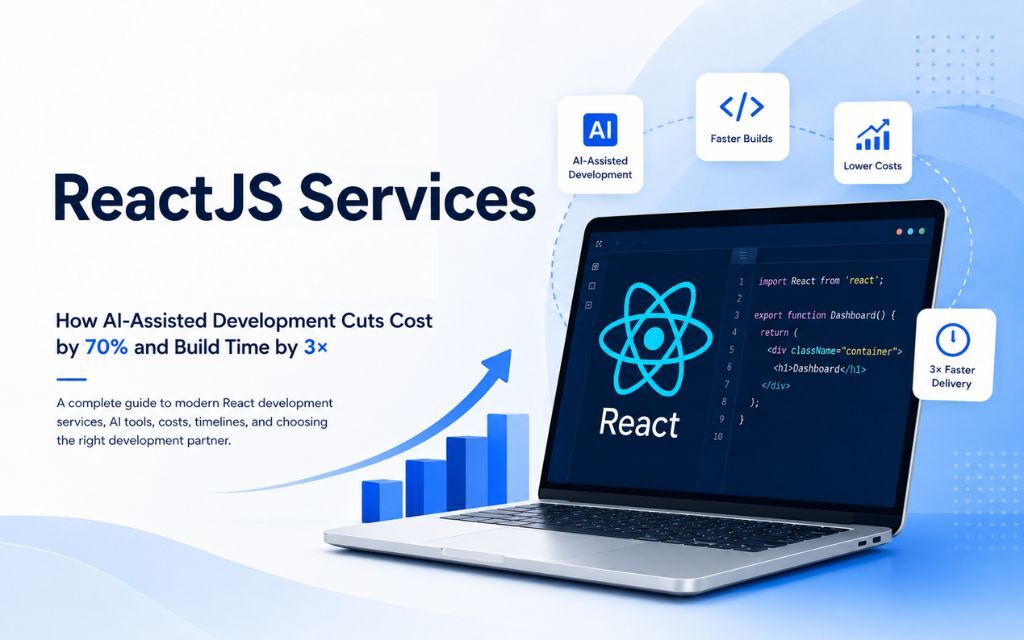
If you’ve priced out a React project recently, you already know the math rarely works in your favor. A mid-size web app can run $80,000 to $150,000 and take eight months to ship with a traditional agency. By the time it’s live, the market has moved.
That gap between “when you need it” and “when it’s ready” is where most startups lose ground. In 2026, the teams closing that gap are doing it with AI-assisted React development — not by cutting corners, but by compressing the slow parts of the build cycle without sacrificing quality.
This article breaks down what modern ReactJS services actually look like, where AI is making the biggest difference, and what to look for when choosing a partner to build your next React application.
What ReactJS Services Cover in 2026
ReactJS development has expanded well beyond writing components. A capable React team today handles:
- Custom web application development using React 18+ with concurrent rendering, Suspense, and server components
- React Native mobile apps for iOS and Android from a shared codebase
- State management architecture using Redux Toolkit, Zustand, or Jotai, depending on app complexity
- API integration and backend connectivity with REST, GraphQL, and real-time WebSocket layers
- Performance optimization, including code splitting, lazy loading, and Core Web Vitals tuning
- UI/UX design and component systems built on Tailwind CSS, MUI, or custom design tokens
- Testing and QA covering unit, integration, and end-to-end test coverage
- DevOps and deployment to AWS, Vercel, or containerized cloud environments
When you hire a ReactJS development partner, you’re not just buying code. You’re buying a process that takes your product from concept to production without gaps.
Where AI Cuts React Build Time by 3×
The 3× speed claim isn’t marketing shorthand. It reflects what happens when AI tooling is embedded at every stage of the development cycle — not bolted on at the end.
Here’s where the time actually gets saved:
Component Scaffolding and Boilerplate
Tools like GitHub Copilot and Cursor generate component scaffolding, prop type definitions, and hook patterns in seconds. A developer who used to spend 45 minutes building a reusable data table component from scratch now reviews and refines an AI-generated version in under 10 minutes. Multiply that across dozens of components in a typical app and the hours add up fast.
Code Review and Refactoring
AI-assisted code review catches common React anti-patterns — unnecessary re-renders, prop drilling issues, missing dependency arrays in useEffect — before they reach production. That reduces the back-and-forth review cycles that quietly stretch timelines by days or weeks.
UI Prototyping with No-Code Tools
Platforms like v0.app and Lovable.dev let teams generate functional React UI prototypes from a plain-language description. A founder can describe a dashboard layout in a prompt and get working JSX back in minutes. That prototype feeds directly into the development sprint rather than sitting in a Figma file waiting for a handoff.
Automated Testing
AI-assisted QA tools generate test cases from existing component logic. Instead of writing tests after the fact, coverage grows alongside the build — compressing the QA phase that traditionally adds two to four weeks at the end of a project.
Deployment Automation
AI-integrated CI/CD pipelines catch environment mismatches, flag dependency conflicts, and automate steps that used to require manual intervention. Fewer deployment failures means fewer rollback cycles eating into your timeline.
The Real Cost Difference
Traditional React development agency: $100,000 average for a mid-complexity web application, delivered in six to nine months.
AI-assisted React development: closer to $30,000 for comparable scope, delivered in two to four months.
That’s not a hypothetical. It reflects the actual cost structure when AI handles the repetitive, time-intensive parts of the build and senior engineers stay focused on architecture, logic, and the decisions that require genuine judgment.
For a seed-stage startup with $500,000 in runway, the difference between a $100K eight-month build and a $30K three-month build isn’t just a line item. It’s the difference between having budget left to iterate and running out of money before you find product-market fit.
What to Look for in a ReactJS Development Partner
Not every agency that mentions AI in its pitch is actually using it in production. Here’s what separates genuine AI-native React teams from those using it as a buzzword:
Named tools in active use. A credible team names the tools: Cursor, GitHub Copilot, v0.app, Tabnine. Vague references to “AI-powered development” without specifics are a red flag.
Measurable delivery claims. Look for specific timelines and cost comparisons backed by case studies, not just marketing copy.
Full-stack ownership. React apps don’t exist in isolation. Your partner should handle backend integration, cloud deployment, and QA under one roof. Handoffs between separate vendors add time and risk.
Certified infrastructure. AWS certification matters when your React app needs to scale. Laravel certification matters if your API layer runs on PHP. These credentials signal a team that has been tested against real production standards.
Flexible engagement models. A fixed-price model protects your budget on a defined scope. A dedicated team model works when you need ongoing velocity. The right partner offers both.
How AvyaTech Approaches React Development
AvyaTech builds React applications using an AI-integrated development process that covers the full lifecycle: discovery, UI/UX design, development, QA, and deployment.
The team uses GitHub Copilot and Cursor for AI-assisted coding, v0.app and Lovable.dev for rapid UI prototyping, and BrowserStack for cross-browser QA. React builds are deployed to AWS-certified infrastructure, with DevOps pipelines configured to reduce manual deployment overhead.
The result is a delivery timeline of two to four months for projects that would typically take six to twelve months at a traditional agency — at roughly 30 to 40 percent of the cost.
AvyaTech works with startups from the MVP stage through Series B, as well as mid-market companies modernizing legacy web systems. Three engagement models are available: Fixed Price, Time and Materials, and Dedicated Team. The starting point is a free AI consultation with no commitment required.
React in 2026: What’s Driving Demand
A few factors are pushing React development demand higher this year:
React Server Components are now mainstream. RSC shifts rendering logic to the server, reducing client-side JavaScript and improving initial load performance. Teams that haven’t migrated are watching their Core Web Vitals scores fall behind competitors.
AI-powered UIs are React-first. Most AI chatbot interfaces, streaming response UIs, and generative AI front-ends are built in React. If you’re adding AI features to your product, React is the default choice.
The no-code-to-code pipeline. Founders are increasingly using no-code tools to prototype, then handing off to React developers to productionize. Agencies that can work fluidly across both stages move faster.
Mobile parity expectations. Users expect your web app and mobile app to behave consistently. React and React Native sharing component logic is the most practical path to that parity without doubling your development cost.
Common Mistakes When Hiring for ReactJS Services
Hiring for React skills without checking architecture experience. A developer who writes clean components but doesn’t understand state management at scale will create technical debt that slows you down six months in.
Choosing the lowest hourly rate. Offshore teams with low rates often offset those savings with slower communication, rework, and QA gaps. Total project cost matters more than hourly cost.
Skipping the discovery phase. Jumping straight into development without proper solution design is the most reliable way to build the wrong thing. A good React partner insists on discovery before writing a line of code.
Underestimating QA. React apps with poor test coverage break silently. Automated testing built into the development process isn’t optional — it’s what separates a stable production app from one that generates support tickets.
FAQs
Most ReactJS services cover custom web application development, component architecture, API integration, state management, performance optimization, UI/UX design, QA and testing, and cloud deployment. The scope varies by provider, but a full-lifecycle partner handles all of these under one engagement.
Cost depends on project complexity, team size, and engagement model. AI-assisted React development can reduce costs significantly compared to traditional agencies. A mid-complexity web application that would cost $80,000 to $100,000 at a traditional agency can often be delivered for $25,000 to $40,000 when AI tooling is embedded throughout the build process.
Traditional timelines run six to twelve months for a mid-to-large React application. AI-assisted development compresses that to two to four months for comparable scope by automating component scaffolding, code review, testing, and deployment steps.
React is used for web applications that run in a browser. React Native is used to build iOS and Android mobile apps using the same component model. Many teams use both together to share logic across web and mobile surfaces, reducing overall development effort.
Fixed-price works well when your scope is well-defined upfront and you want budget certainty. Time-and-materials works better for projects where requirements are likely to evolve — such as early-stage products still finding product-market fit. A dedicated team model suits ongoing development where you need consistent velocity over months.
Ask them to name the specific tools they use and how those tools fit into their workflow. A genuine AI-native team will reference tools like Cursor, GitHub Copilot, v0.app, or Tabnine and explain exactly where they’re applied. Vague answers about “AI-powered processes” without tool names are a sign that AI is marketing language rather than operational practice.
React Server Components for improved performance and reduced client-side JavaScript, concurrent rendering for smoother user interactions, and streaming UI patterns for AI-powered features are the three highest-impact areas right now. If your app hasn’t adopted RSC yet, that’s the most important architectural upgrade to address.