





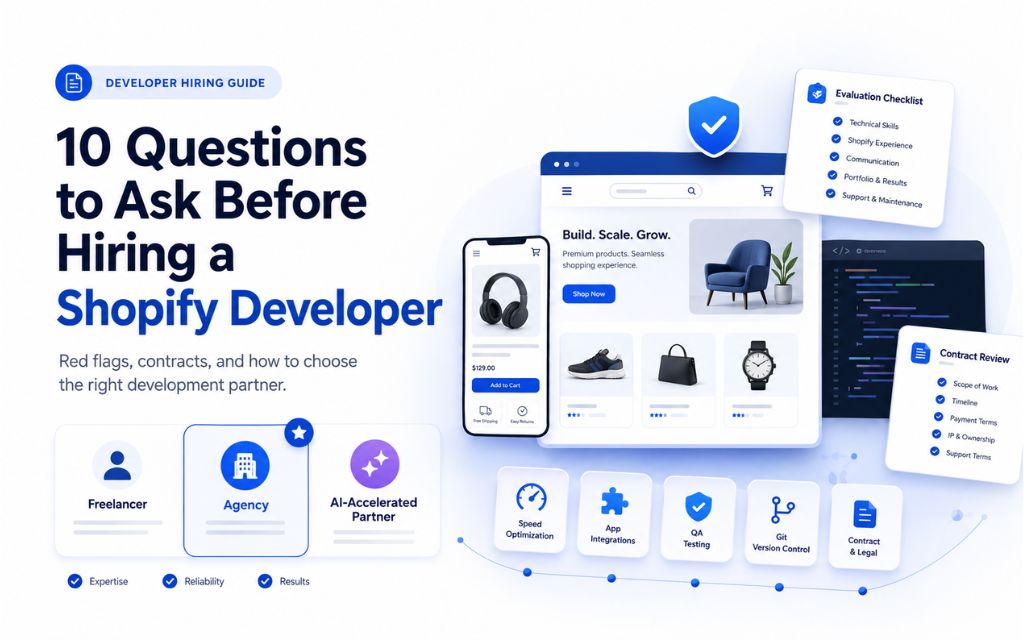
Most Shopify projects go sideways not because the developer lacked technical skill, but because the wrong questions were never asked before the contract was signed. You end up with a store that looks fine in staging and breaks on mobile, or a checkout flow nobody can maintain once the developer is gone.
If you’re about to hire a Shopify developer in 2026, this guide gives you the exact questions to ask, the red flags to watch for, and a clear framework for choosing between a freelancer, an agency, and an AI-accelerated development partner.
Why Hiring a Shopify Developer Is Harder Than It Looks
Shopify has matured significantly. The platform now supports complex headless builds, custom app development via the Admin API, multi-currency storefronts, B2B functionality, and deep third-party integrations. A developer who was solid in 2022 may have no experience with Shopify’s current architecture.
The market doesn’t make this easier. It’s flooded with generalist developers who list Shopify on their profile but have never built a custom theme from scratch or wired up a real-time inventory system. Sorting signal from noise takes time you probably don’t have.
The questions below help you do that fast.
The 10 Questions to Ask Before You Sign
1. Have you built on Shopify 2.0 themes, or only legacy themes?
Shopify’s Online Store 2.0 introduced section-everywhere functionality, app blocks, and metafields. A developer still working primarily in Debut or Narrative themes is behind. Ask them to walk you through a recent 2.0 build and explain how they structured the sections.
2. Can you show me a store you built that handles more than 10,000 SKUs?
Scale exposes weak architecture. Large catalogs stress collection filtering, search indexing, and page load times. If a developer has only built small boutique stores, that’s not automatically disqualifying — but you need to know it upfront.
3. How do you handle Shopify app conflicts?
Most stores run 10 to 20 apps. Conflicts between them — especially around the cart, checkout, and theme JavaScript — are one of the most common sources of production bugs. Ask how they diagnose and resolve these. A vague answer is a warning sign.
4. What’s your approach to page speed and Core Web Vitals?
Google’s Core Web Vitals directly affect your organic rankings and paid ad Quality Scores. Ask specifically about Largest Contentful Paint (LCP) and Cumulative Layout Shift (CLS). A developer who can’t explain how they optimize these metrics isn’t the right hire for a growth-stage store.
5. Do you write custom Shopify apps, or only use existing ones?
There’s a meaningful gap between a developer who installs and configures apps and one who can build a custom private app using Shopify’s APIs. If your requirements go beyond what off-the-shelf apps handle, you need the latter.
6. How do you manage version control and handoffs?
Every professional Shopify developer should use Git. Ask where the repository lives, how they handle branching, and what the handoff process looks like at project end. If they’re working directly on the live theme without version control, stop the conversation there.
7. What does your QA process look like before launch?
Get specific: what devices do you test on, how do you handle cross-browser testing, and what does your pre-launch checklist cover? Developers using tools like BrowserStack for systematic cross-device testing are operating at a different standard than those who manually check on their laptop and phone.
8. How do you handle post-launch bugs?
Bugs appear after launch. The question is whether the developer has a defined process for handling them — what the response time looks like, and whether post-launch support is included in the contract or billed separately. Get this in writing.
9. Have you integrated with [name your specific third-party tools]?
If your store needs to connect with a specific ERP, CRM, fulfillment provider, or payment gateway, ask directly whether they’ve done that integration before. Shopify’s API is well-documented, but integration complexity varies enormously. Prior experience matters.
10. What’s your pricing model, and what does the contract actually cover?
Fixed-price contracts protect you when scope is well-defined. Time and material works better for exploratory or iterative builds. Understand exactly what’s included, what triggers a change order, and who owns the code at the end. Opaque pricing is a risk, not a negotiation tactic.
Freelancer vs. Agency vs. Full-Stack Development Partner
Your choice here depends on scope, timeline, and how much internal capacity you have to manage the project.
| Factor | Freelancer | Traditional Agency | AI-Accelerated Agency |
| Cost | Lowest | Highest | Up to 70% less than traditional |
| Timeline | Variable | 6–12 months typical | 2–4 months |
| Scope coverage | Narrow | Broad but siloed | End-to-end under one roof |
| Accountability | Single point of failure | Account manager layer | Dedicated team, fixed-price option |
| Best for | Small, well-scoped tasks | Large enterprise builds | Startups and growth-stage teams |
A freelancer is fine for a theme tweak or a single app integration. For a full store build, a migration, or a Shopify Plus implementation with custom checkout logic, you need a team.
The gap between a traditional agency and an AI-accelerated one is becoming harder to ignore. Traditional agencies still run 6-to-12-month timelines for complex builds. Teams that embed AI coding tools like GitHub Copilot, Cursor, and Amazon Q into the actual development workflow — not as a talking point, but in daily use — can compress that to 2 to 4 months without sacrificing quality.
Red Flags to Watch For
They can’t show you live stores they’ve built. Portfolio work should be verifiable. Ask for URLs, not screenshots.
They quote a fixed price before understanding your requirements. A number thrown out before a discovery conversation isn’t a real estimate.
They don’t ask about your integrations upfront. A developer who doesn’t ask what tools your store connects to hasn’t thought seriously about your project yet.
They’re vague about who actually does the work. Some agencies sell the engagement and subcontract the build. Know who is writing your code.
No mention of testing or QA. If their process goes straight from build to launch with no testing phase, you’ll find the bugs in production.
What to Include in the Contract
Before you sign anything, make sure these items are explicitly covered:
- Scope definition: What is built, and what is explicitly out of scope
- Milestone and payment schedule: Tied to deliverables, not calendar dates
- Revision rounds: How many are included, and what counts as a revision versus a new request
- IP ownership: You should own the code at project end
- Post-launch support: Duration, response time, and whether it’s included or billed separately
- Change order process: How scope changes are priced and approved
- Access and credentials: Who holds admin access during and after the project
A developer or agency that resists putting any of these in writing is telling you something important.
When You Need More Than a Shopify Developer
Some projects start as Shopify builds and reveal a larger need: custom inventory logic, AI-powered product recommendations, a mobile app that mirrors the storefront, or a back-office ERP integration that Shopify’s native tools can’t handle.
If your requirements are heading in that direction, you’re not looking for a Shopify specialist anymore — you need a full-stack development partner. AvyaTech builds across web, mobile, cloud, and AI, with Adobe Commerce certification alongside Shopify-adjacent e-commerce experience. For teams that have outgrown what a single-platform developer can deliver, having that end-to-end capability under one roof makes a real difference.
Frequently Asked Questions
Rates vary widely. Freelancers typically charge $50 to $150 per hour depending on location and experience. Agencies range from $100 to $250 per hour, with project minimums often starting at $10,000 to $15,000 for a full build. AI-accelerated agencies can deliver comparable output at significantly lower total cost — sometimes 50 to 70 percent less than a traditional agency engagement.
Shopify Plus unlocks features not available on standard plans: checkout extensibility via Checkout UI Extensions, custom B2B pricing, multi-store management through the Organization Admin, and higher API rate limits. A Plus-experienced developer understands how to use these features and where the platform’s limits still apply.
For small, well-defined tasks, a freelancer works. For a full store build, a migration from another platform, or a project that involves custom app development and integrations, an agency or full-stack development partner gives you more accountability, a broader skill set, and a defined process.
A basic theme customization takes days. A full custom build with integrations typically takes 6 to 12 weeks with a traditional agency. AI-accelerated development teams can compress complex builds to 4 to 8 weeks without cutting corners on QA.
Ask whether the developer understands structured data markup, canonical tag management, URL structure best practices for collections and products, and how they handle redirect mapping during a platform migration. SEO mistakes made at the build stage are expensive to fix after launch.
Headless Shopify separates the storefront presentation layer from Shopify’s back-end commerce engine, typically using a framework like Next.js or Nuxt. It gives you more control over performance and design but adds significant complexity and cost. Most stores don’t need it. If you’re running a high-traffic brand with very specific performance requirements or a custom content experience, it’s worth evaluating.
Ask for live store URLs, not just screenshots. Request references from past clients. Ask them to walk you through a specific technical decision they made on a recent project and why. Genuine experience shows in the specifics — surface-level familiarity doesn’t hold up under direct questions.