




The market for generative AI software has crossed $37 billion and is growing at nearly 40% a year. Most businesses are still figuring out what that means for them. This guide covers the technical foundations, the build-vs-buy decision, the development process, and how to evaluate a partner — with honest numbers throughout.
88% of global organizations use AI in at least one business function (McKinsey, 2025)
5.8×average ROI for AI-mature companies within 14 months of production deployment (McKinsey, 2025)
44% of AI projects achieve positive ROI in year one — execution is the differentiator (Forrester, 2025)
Related reading in this pillar
- Custom LLM Development: When It’s Worth It and How to Plan It — a deeper look at fine-tuning vs. training from scratch
- AI Agent Development: Architectures, Frameworks, and Production Considerations — building systems that take multi-step actions, not just generate text
- ChatGPT Integration for Business: A Technical and Strategic Guide — connecting OpenAI’s APIs to existing products and workflows
- Prompt Engineering: Principles, Patterns, and Production Practices — how to get reliable outputs from foundation models
AI Chatbot Development: Beyond the FAQ Bot — building conversational AI that handles real customer interactions
What generative AI development actually means
Generative AI development is the process of building software that uses large language models (LLMs) or generative models to produce new content — text, code, images, audio, or structured data — in response to input.
It is distinct from traditional software development in one fundamental way: you are not writing rules that tell the system what to output. You are selecting or training a model that learns to generate outputs from patterns in data, then building the application layer that makes that model useful for a specific purpose.
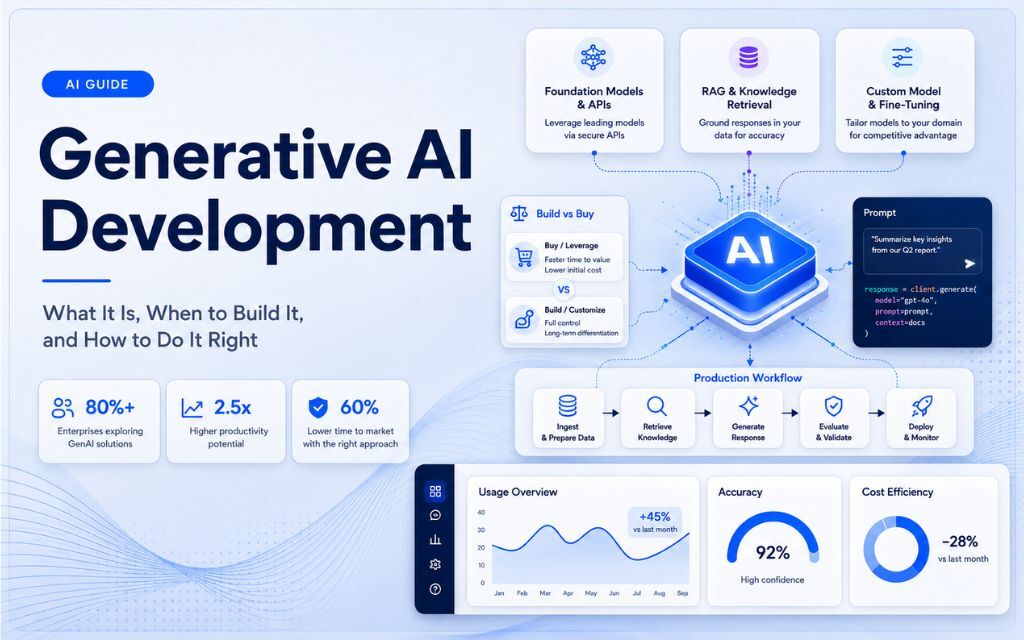
In practice, most generative AI projects in 2026 fall into one of three categories. The first is integration work — connecting an existing foundation model API (OpenAI, Anthropic, Google, or an open-weight model) to a product or internal workflow via prompt engineering, context management, and output handling.
The second is Retrieval-Augmented Generation (RAG), which connects an LLM to a company’s own knowledge base so it can answer questions using proprietary content without retraining the model.
The third is fine-tuning or custom model development, where a foundation model is adapted — or in rare cases, trained from scratch — on a company’s own data to improve performance on a specific domain or task.
The terminology in this space is used loosely by vendors, which creates confusion. “Building a custom AI” can mean anything from writing a system prompt for GPT-4o to training a 7-billion-parameter model on your proprietary dataset. The distinction matters enormously for budget, timeline, and realistic expectations.
72% of organizations now use generative AI in at least one business function — up from 37% in 2023. Enterprise GenAI spending grew 222% between 2024 and 2025, reaching $37 billion.McKinsey State of AI, 2025 · Menlo Ventures, 2025
What changed the landscape in 2024 and 2025 was not a single breakthrough — it was the convergence of capable foundation models available via API, dropping inference costs (LLM inference prices fell between 9× and 900× per token in a single year, depending on the model), and a growing ecosystem of tooling that makes integration work faster and more reliably.
The barrier to experimenting has collapsed. The barrier to deploying something that is genuinely useful in production has not — which is why 56% of CEOs in a PwC January 2026 survey reported zero measurable ROI despite AI deployment.
How do LLMs and generative models work?
A large language model is a neural network trained on very large quantities of text to predict the next token in a sequence. “Token” roughly means a word fragment — GPT-4o processes about 750 words per 1,000 tokens.
The model is trained by feeding it billions of text samples and adjusting its internal parameters (weights) to make correct next-token predictions more likely. After training, the model has compressed statistical patterns about language, facts, reasoning, and style into those weights.
When you send it a prompt, it generates a response by sampling from the probability distribution it learned — one token at a time.
The insight that made today’s models possible was the Transformer architecture (Vaswani et al., 2017), which introduced self-attention mechanisms allowing a model to relate any part of an input to any other part simultaneously, regardless of distance.
Before Transformers, language models processed sequences left-to-right with quickly fading memory of what came before. Transformers gave models the ability to maintain rich context across long inputs, which is what makes it possible for a modern LLM to read a 50-page legal document and reason about a clause on page 47 in relation to a definition on page 3.
Foundation models vs. fine-tuned models vs. custom models
A foundation model — such as GPT-4o, Claude 3.7, or Llama 3.3 — is trained on broad internet-scale data to be capable at a wide range of tasks. It has general knowledge, language ability, and reasoning competence that makes it useful out of the box for most text-related tasks.
Most enterprise generative AI projects start here, using the foundation model via an API with a carefully constructed system prompt.
Fine-tuning takes a foundation model and continues training it on a smaller, task-specific dataset — typically thousands to tens of thousands of examples in a format relevant to your use case.
A customer support model fine-tuned on five years of your support tickets will produce outputs that match your brand voice, use your product terminology correctly, and handle your category-specific edge cases better than a general-purpose model can.
Fine-tuning does not give the model new factual knowledge beyond its training cutoff, but it does change its style, format, and domain fluency.
Training a model from scratch means initializing a new architecture with random weights and training on your own dataset from the beginning.
This is appropriate for very large companies with truly proprietary data distributions that differ fundamentally from what any foundation model has seen — healthcare imaging from a rare disease population, proprietary financial instrument data with no public analogue, industrial sensor data from processes with no public documentation. For the overwhelming majority of business use cases, it is unnecessary and cost-prohibitive.
“The choice between custom AI development and off-the-shelf AI is a money decision dressed up as a technology decision.”
— Ariel Software Labs, Custom AI Model Development: Build vs Buy Guide, 2026
What is RAG and why does it matter?
Retrieval-Augmented Generation connects an LLM to an external knowledge base at inference time. When a user asks a question, the system first retrieves the most relevant documents, passages, or database records from your knowledge store, then passes them as context to the LLM alongside the question. The LLM generates an answer grounded in your content rather than in its training data alone.
RAG is the most practical approach to giving AI systems access to proprietary knowledge — product documentation, internal procedures, past case decisions, technical specifications — without the cost or complexity of fine-tuning.
It is also updatable in real time: add a new document to your knowledge base and the system can use it immediately, without retraining anything. For most knowledge management and customer-facing information retrieval use cases, RAG plus a well-chosen foundation model outperforms a fine-tuned model at a fraction of the cost.
The build-vs-buy decision: a practical framework
The most expensive mistake in enterprise AI is not choosing the wrong model — it is misreading which decision you are actually making. Companies spend months and hundreds of thousands of dollars building custom AI infrastructure for use cases where an off-the-shelf subscription would have produced equivalent results in two weeks. Equally, companies sign long-term SaaS contracts for AI tools when their competitive advantage is entirely locked in proprietary data that a custom system could unlock.
The right question is not “custom or off-the-shelf?” but “where does my data or my workflow create differentiation that no generic product can replicate?” The answer to that question tells you where to build and where to buy.
When off-the-shelf is almost always right
For standard business functions — marketing copy generation, meeting summarization, basic document review, customer support tier-one triage, code autocompletion — mature SaaS products exist that are highly refined and priced per seat.
If a subscription tool solves 90% or more of your problem, custom development is an expensive mistake. Startups validating product assumptions should use off-the-shelf tools to preserve capital until they have clear evidence that a generic model’s limitations are costing them measurable business value.
When is custom development justified?
Custom development is justified under four conditions. First, your proprietary data would meaningfully improve outputs in ways no generic model can replicate — for example, a fraud detection system trained on eight years of your specific transaction patterns.
Second, regulatory or security requirements prohibit sending data to third-party APIs — relevant for regulated industries including financial services, healthcare in many jurisdictions, and enterprise contracts with strict data residency clauses.
Third, AI inference is core to your product at a scale where API costs exceed the total cost of ownership of a self-hosted model. Fourth, no off-the-shelf tool produces output quality sufficient for your use case after prompt engineering and RAG have been applied.
40% of enterprise applications are forecast to embed task-specific AI agents by end-2026, up from under 5% in 2025 — but over 40% of agentic AI projects are expected to be cancelled by 2027 due to unclear ROI and weak risk controls.Gartner, 2025
The hybrid approach that most enterprises land on
In practice, the clearest path for most mid-to-large enterprises is a hybrid architecture: buy frontier model API access as commodity infrastructure, then build the application layer — the retrieval system, the context management logic, the output validation, the integration with existing systems — where your business logic and data create real differentiation.
You are not renting intelligence from OpenAI or Anthropic in this model; you are using their compute to run inference on inputs and prompts you control, against knowledge you own. The application layer is yours, the model is a commodity service, and switching between foundation model providers remains practical as the market evolves.
Custom vs. off-the-shelf: a full comparison
| Dimension | Off-the-shelf AI (SaaS) | Foundation model API + custom app layer | Fine-tuned or custom model |
| Time to first value | Days to weeks | 4–16 weeks (POC to MVP) | 3–9 months |
| Upfront cost | Low (subscription) | $30K–$80K for MVP | $100K–$500K+ |
| Long-term cost | Scales with seats/usage; vendor controls pricing | API costs scale with usage; manageable | Lower marginal inference cost at scale; maintenance 15–25% of build cost annually |
| Data privacy | Data shared with vendor; review DPA carefully | Data sent to foundation model provider; zero-data-retention options exist | Full data control; can be self-hosted in private cloud |
| Domain accuracy | General-purpose; acceptable for standard tasks | Good with well-designed prompts and RAG | Highest for specific domain given sufficient training data |
| Competitive advantage | None; competitors use same tools | Moderate; differentiation comes from application layer | High; model itself is a proprietary asset |
| Vendor lock-in | High; dependent on vendor roadmap and pricing | Moderate; switching foundation models is feasible | Low for self-hosted; model is owned |
| Right for | Standard functions; early-stage validation; budget-constrained teams | Most business use cases; products where AI is a feature | Regulated industries; AI-core products; unique proprietary data |
The generative AI development process, phase by phase
A production-grade generative AI system involves more than prompting a model and shipping the output. The development process is a sequence of distinct phases, each with its own deliverables and failure modes. Skipping phases — particularly evaluation and safety testing — is the most common reason AI projects either fail to reach production or cause problems after they do.
PHASE 01: Use Case Definition & Feasibility
Define the task precisely, identify the data available, set measurable success criteria, and assess whether AI is the right tool at all.
PHASE 02: Architecture Design
Select the model tier (off-the-shelf, API, fine-tuned), design the retrieval and context layer, define the integration points with existing systems.
PHASE 03: Proof of Concept
Build a minimal working version in 4–8 weeks. Validate the core assumption — that the model can perform the task at acceptable quality — before investing in infrastructure.
PHASE 04: Evaluation Framework
Build a benchmark dataset with human-labelled ground truth. Establish automated evals that can run with every deployment. Define quality thresholds that trigger human review.
PHASE 05: Production Build & Integration
Build the application layer: API integrations, context management, output validation, safety filters, latency optimization, logging, and observability.
PHASE 06: Safety, Compliance & Hardening
Red-team the system for adversarial inputs, hallucination risk, and unintended outputs. Review against data protection obligations. Implement guardrails and audit trails.
The median time-to-value for enterprise AI agent deployments in 2026 is approximately 5.1 months from project start to a system that delivers measurable business outcomes, according to BCG and Forrester research. Projects that rush past the evaluation framework phase account for a disproportionate share of the 40% of agentic projects Gartner expects to be cancelled before 2027.
High-ROI use cases by industry
Generative AI’s value is unevenly distributed across use cases. Customer service (56%), IT operations (51%), and marketing (48%) are the three business functions reporting the widest production AI deployment, according to 2026 enterprise survey data.
Within those categories, the highest-ROI applications share a common structure: they operate on well-structured input data, their outputs are verifiable by humans or automated systems, and the cost of a wrong output is recoverable rather than catastrophic.
Software development
Coding assistance is the first use case that reached genuine scale in the enterprise. AI-assisted software developers produce 40–55% more code per week compared to unassisted developers, according to GitHub Copilot research, and the technology has reached 90% of Fortune 100 companies.
The highest-value implementations go beyond autocomplete to include AI-assisted code review, test generation, documentation, and architectural analysis of legacy codebases.
Customer support automation
AI chatbots built on modern LLMs with RAG over product documentation and support history resolve 68% of tier-one support tickets without human escalation, based on 2026 deployment data.
The ROI case is clearest for teams handling high volumes of relatively predictable queries — the use case breaks down when queries require judgment, policy exceptions, or access to systems the AI cannot reach.
Legal, compliance, and document intelligence
For law firms, financial services companies, and compliance-heavy enterprises, LLMs fine-tuned on internal documents and paired with robust retrieval systems can transform how teams access and apply institutional knowledge.
Contract review, due diligence, and regulatory change monitoring are the leading use cases. The compliance argument for custom development is strongest here: in regulated sectors, the ability to audit, explain, and control every AI output is often a legal obligation, not a preference.
Marketing and content operations
More than 37% of businesses in the marketing and advertising industries have adopted generative AI in their workflows.
The pattern that delivers value is using AI to handle volume — first drafts of SEO content, ad copy variants, email personalization at scale, creative briefs — while keeping human judgment in the loop for brand voice, strategic positioning, and final approval.
AI-only content workflows without human review have produced reputational and accuracy problems at scale for several major brands.
37% average productivity improvement in roles augmented by AI tools, compared to 12% from traditional automation alone. The gains are highest for knowledge workers handling repetitive, high-volume tasks with verifiable outputs. Accenture, 2025
How to evaluate a generative AI development partner
The generative AI development vendor landscape in 2026 includes legitimate specialists, traditional development agencies that have added an AI practice page, and pure-prompt shops that use API calls but call it “custom AI.” Distinguishing between them requires asking specific technical questions and scrutinising the answers.
Questions worth asking every prospective partner
Ask how they handle evaluation and measurement before you ask about their technology stack. A partner that cannot describe how they will measure whether the system is working — concrete metrics, benchmark datasets, automated evals — will ship something that looks like it works in a demo and fails quietly in production. Ask for examples of evaluation frameworks they have built for prior clients, not just system demos.
Ask specifically about their experience with the failure modes of generative AI systems: hallucination in RAG pipelines, prompt injection attacks, context window management at scale, latency under production load, and cost management as usage grows.
These are solved problems with known patterns — a team that has not encountered them in production has not shipped production systems.
Ask who owns the code, the model weights (if fine-tuning is involved), and the evaluation datasets. Ask what happens to your data during development and after the engagement ends. These are contractual questions as much as technical ones, and the answers matter for your long-term competitive position.
Finally, ask for a clearly scoped proof-of-concept engagement before committing to a full build. Any serious team should be able to deliver a working POC in 4–8 weeks that validates the core technical assumption of your use case. If a partner resists scoping a POC and pushes directly to a six-month full build, treat that as a signal.
“Implementation services currently capture 35% of the generative AI market revenue — most enterprises need extensive integration work, governance frameworks, and workflow redesign before deployment.”
— New Market Pitch, Generative AI Market Size 2026 Analysis
Frequently asked questions
Generative AI development is the process of building software applications that use large language models (LLMs) or diffusion models to produce new content — text, code, images, audio, or video — in response to user input. It encompasses API integration with models like GPT-4o and Claude, fine-tuning existing models on proprietary data, building retrieval-augmented generation (RAG) systems, and in some cases training custom models from scratch.
A proof-of-concept typically takes 4–8 weeks. An MVP built on existing foundation model APIs usually ships in 8–16 weeks. A full production system with custom fine-tuning, enterprise integrations, and compliance hardening typically takes 4–9 months. The median time-to-value across enterprise AI agent deployments in 2026 is approximately 5.1 months from project start to measurable business outcomes (BCG and Forrester, 2026).
Most businesses should start with off-the-shelf foundation model APIs and build custom application logic on top. Fine-tuning or training from scratch is justified when you have large volumes of proprietary data that would meaningfully improve outputs, when compliance rules prohibit sending data to third-party APIs, or when your AI use case is core to your product at a scale where API costs exceed the cost of ownership of a self-hosted model.
A proof-of-concept typically costs $8,000–$25,000. An MVP on foundation model APIs runs $30,000–$80,000. A full production system with fine-tuning or custom architecture typically starts at $100,000 and can exceed $500,000 for enterprise-grade systems with compliance, security, and integration work included. The median mid-market custom AI project cost $87,000 in total in 2025 (Clutch AI Development Pricing Report, 2025). Ongoing maintenance typically costs 15–25% of the original build cost annually.
Retrieval-Augmented Generation (RAG) connects an LLM to an external knowledge base at inference time, allowing it to answer questions using your documents, databases, or internal content rather than only its training data. RAG is one of the most practical and cost-effective approaches to giving an AI system access to proprietary knowledge without fine-tuning the model itself, and it supports real-time updates to your knowledge base without retraining.
Traditional machine learning models are trained to classify, predict, or rank — they produce a label or a score from a fixed set of outputs. Generative AI models produce new, open-ended content: a paragraph, a block of code, an image, a synthetic dataset. The distinction matters for project planning because generative AI outputs require different evaluation methodologies, safety testing approaches, and quality assurance processes than classification or prediction systems do.
The measurement approach depends on the use case, but every production system should have: a benchmark dataset with human-labelled ground truth (what the correct output looks like), automated evaluation metrics tied to your specific quality criteria, monitoring for output drift over time, and defined thresholds that trigger human review. Measuring token cost per task and latency is also necessary for production systems. Skipping the evaluation framework is the most common reason AI projects fail after deployment.