




You’ve scoped your project, you have a budget, and now you’re looking at three engagement options: Fixed Price, Time and Materials, and Dedicated Team. The first two feel familiar. The third raises questions. What exactly do you get? Who manages the work? How does it compare on cost and control?
This article breaks down the dedicated team model clearly — what it is, when it makes sense, when it doesn’t, and how AI-accelerated teams are changing what “dedicated” actually means in 2026.
What the Dedicated Team Model Actually Means
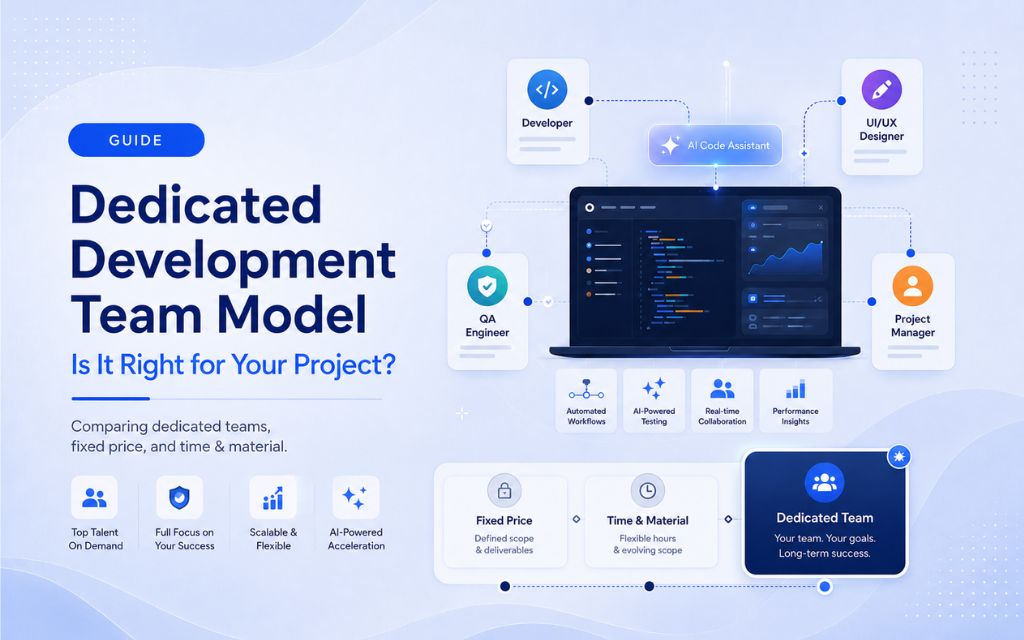
A dedicated development team is a group of engineers, designers, and QA specialists assembled specifically for your project — working exclusively on your product for the duration of the engagement. You’re not sharing capacity with other clients. The team operates as a direct extension of your own staff.
Typically, you get a defined roster: one or more developers, a project manager, a UI/UX designer, and a QA engineer. That composition shifts based on your project phase. Early on, you might need more design and architecture work. Later, the balance moves toward engineering and testing.
The vendor handles HR, benefits, tooling, and infrastructure. You direct the work. That’s the core trade-off: you get control over priorities without taking on the overhead of full-time hires.
How It Compares to Fixed Price and Time and Materials
The dedicated team model is easier to understand when you place it next to the alternatives.
Fixed Price
You define scope upfront. The vendor delivers to spec at an agreed cost. This works well when requirements are clear and unlikely to change. The risk is that any scope creep becomes a negotiation, and you end up paying for the vendor’s buffer against uncertainty.
Time and Material
You pay for hours worked. Scope can flex. Good for exploratory or iterative work, but budget predictability suffers — and without strong project management on your side, costs drift.
Dedicated Team
You pay for a team’s capacity over a defined period, usually monthly. Scope can change freely. You control priorities sprint by sprint. Cost is predictable at the team level even when deliverables shift. This model suits projects that are long-running, complex, or evolving.
In practice, the dedicated model sits between the other two: more flexible than Fixed Price, more structured than Time and Material.
When the Dedicated Team Model Makes Sense
Not every project fits this model. Here’s where it genuinely performs well.
Your product roadmap is still evolving. If you’re post-MVP and iterating based on user feedback, locking scope upfront works against you. A dedicated team lets you redirect priorities without renegotiating a contract every two weeks.
You need deep product context. A team that works exclusively on your product for six or twelve months builds real institutional knowledge — your architecture, your edge cases, your business logic. That’s hard to replicate with a rotating cast of contractors.
You have internal capacity to direct the work. This model works best when you or your CTO can provide clear direction. The vendor executes; you own the product vision. If you need the vendor to own strategy as well as execution, a full-lifecycle engagement model will serve you better.
You’re scaling after an initial build. You shipped v1 on a fixed-price engagement. Now you need ongoing feature development, performance work, and integrations. A dedicated team is the natural next step.
Your timeline is six months or longer. The onboarding overhead pays off over time. For a six-to-eight week sprint, a project-based model is usually more efficient.
When It Probably Isn’t the Right Fit
The dedicated model has real drawbacks in specific situations.
You need something built fast with a fixed budget. If you’re a seed-stage startup with $40,000 and a hard deadline, a fixed-price engagement gives you cost certainty and a defined deliverable. A dedicated team billed monthly introduces variable risk when runway is tight.
Your requirements are fully defined and unlikely to change. A well-scoped project with stable requirements is a fixed-price job. Paying for ongoing team capacity when scope is already locked is inefficient.
You don’t have bandwidth to manage a team. The dedicated model requires active product direction from your side. If your team is already stretched and you need someone to own the entire development process end to end — from discovery through deployment — look for a vendor that offers full-lifecycle ownership rather than execution-only capacity.
You’re building a one-time integration or a small feature. Scope-limited work doesn’t justify the ramp-up cost of assembling and onboarding a dedicated team.
What AI Does to the Dedicated Team Model in 2026
This is where the model has genuinely changed. A dedicated team in 2026 is not the same as one in 2022.
Agencies that embed AI tooling into their development process produce more output per engineer per sprint. Tools like GitHub Copilot and Cursor accelerate code generation and review. Platforms like v0.app compress UI prototyping from days to hours. Automated testing through BrowserStack catches regressions faster than manual QA cycles ever could.
The practical effect: a three-person AI-assisted team can deliver what a five-person traditional team delivered two years ago. That changes the cost math significantly.
It also changes how you should evaluate vendors. When comparing dedicated team proposals, ask specifically which AI tools are embedded in the daily workflow — not just listed on a capabilities page. There’s a real difference between a team that uses GitHub Copilot every day and a team that mentioned it once in a pitch deck.
At AvyaTech, the dedicated team model runs on the same AI-native stack used across every engagement: Cursor and GitHub Copilot for code generation, v0.app for rapid UI prototyping, BrowserStack for QA, and Amazon Q for cloud-side development. The result is faster sprint velocity without adding headcount.
What to Look for in a Dedicated Team Vendor
If you’re evaluating vendors for a dedicated team engagement, these are the questions that actually matter.
Team composition and seniority. Who specifically will work on your project? What are their backgrounds? Avoid vendors who give you a generic team structure without naming or profiling the actual people.
AI tooling in the workflow. Ask for specifics. Which tools are used at which stages? How do they measure the productivity impact? Vague answers here are a signal worth paying attention to.
Communication and reporting cadence. How often do you get sprint reviews? What does the reporting look like? Dedicated teams work best with weekly syncs and clear sprint documentation.
Engagement flexibility. Can you scale the team up or down based on project phase? Can you bring in a specialist — say, a mobile engineer for a new iOS feature — without restructuring the entire engagement?
Certifications and proven stack. For anything involving cloud infrastructure, AWS certification matters. For e-commerce or Laravel-based systems, relevant certifications reduce delivery risk. These aren’t just credentials — they signal the team has been tested against a defined standard.
Transparent process, not just pricing. Most agencies don’t publish rates, and that’s fine. What matters is whether they can explain their process clearly and back it up with documented case studies from comparable projects.
A Practical Checklist Before You Commit
Before signing a dedicated team agreement, work through these:
- Can you articulate what the team will build in the first 90 days?
- Do you have someone on your side who can run weekly syncs and review sprint output?
- Is your project expected to run at least six months?
- Does your roadmap have enough flexibility that fixed-scope pricing would feel constraining?
- Have you reviewed the vendor’s case studies for projects similar in complexity and domain?
If you answered yes to most of these, the dedicated team model is likely a strong fit. If you hesitated on the first two, consider whether a full-lifecycle partner who owns both strategy and execution might serve you better at this stage.
The Bottom Line
The dedicated team model is a strong choice for the right project: long-running, evolving, and requiring deep product context. It gives you control over priorities without the overhead of direct employment. But it requires active direction from your side, and it’s not the most efficient structure for short, well-scoped work.
In 2026, the model’s value depends heavily on whether your vendor’s team is genuinely AI-accelerated or just traditionally staffed. That difference shows up in sprint velocity, cost per deliverable, and how quickly the team adapts when requirements shift.
If you’re trying to figure out whether a dedicated team engagement fits your project, AvyaTech offers a free AI consultation to walk through your requirements and recommend the right engagement model for your situation.
FAQs
The dedicated team model is an engagement structure where a vendor assembles a team of developers, designers, and QA specialists who work exclusively on your project for an ongoing period, typically billed monthly. You direct the work; the vendor handles HR, tooling, and team management.
Staff augmentation adds individual contractors to your existing team. A dedicated team is a fully assembled unit that operates as a standalone extension of your organization, with its own internal coordination and reporting structure. The dedicated model suits companies without large in-house engineering teams.
Choose a dedicated team when your requirements are likely to evolve, your project will run six months or longer, and you need the team to build deep product context over time. Fixed-price works better when scope is fully defined and budget certainty matters more than flexibility.
AI coding tools like GitHub Copilot and Cursor increase engineer output per sprint, which means a smaller dedicated team can deliver what a larger traditional team would have. This can reduce the monthly cost of a dedicated engagement while maintaining or improving delivery speed.
It depends on project complexity, but a common starting structure is one senior developer, one mid-level developer, one UI/UX designer, one QA engineer, and a project manager. Teams scale up or down based on phase and workload.
Plan for weekly sprint reviews, clear sprint goals set at the start of each cycle, and a defined channel for async updates. The more clearly you communicate priorities, the more the team can execute without bottlenecks. Most dedicated team engagements use tools like Jira, Linear, or Notion for sprint tracking.
Ask who specifically will be on your team, which AI tools they use in their daily workflow, how they handle scope changes mid-sprint, what their escalation process looks like, and whether they can show case studies from projects similar to yours in domain and complexity.