




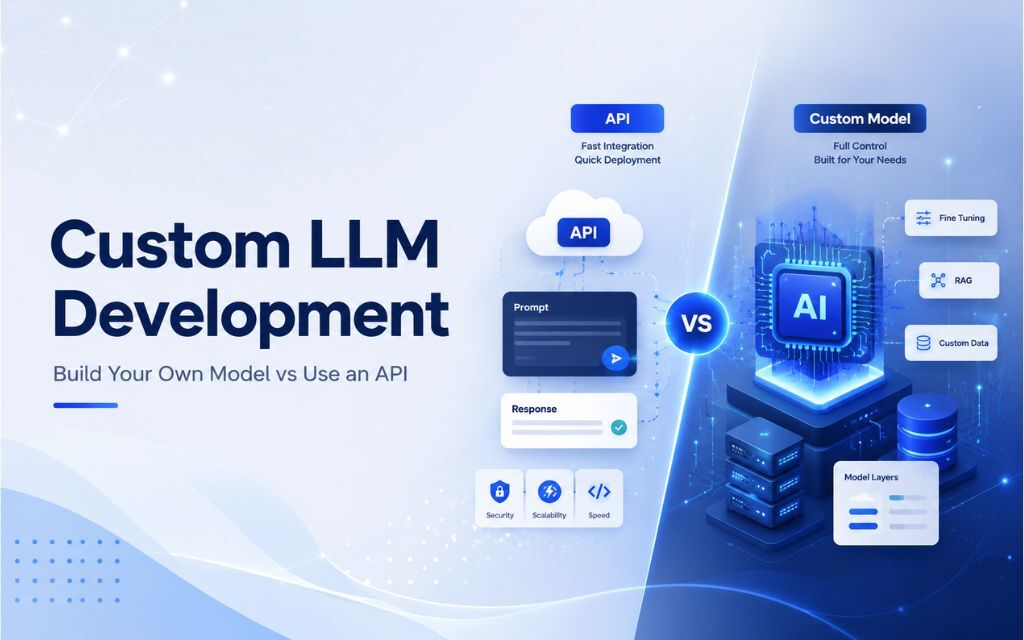
Most teams asking about custom LLM development are really asking a simpler question: do I actually need to build something, or can I just call an API?
It’s a fair question. GPT-5.5, Gemini 3.1 Pro, and Claude 3.5 are genuinely powerful. For many use cases, a well-crafted prompt and a reliable API key will get you 80% of the way there in a week. But for some use cases, that remaining 20% is the entire product. That’s where custom LLM development stops being optional.
This article breaks down the real decision criteria, the cost and timeline tradeoffs, and what a realistic build looks like in 2026 — so your team can make the right call before committing budget.
What “Custom LLM Development” Actually Means
The phrase gets used loosely. Here’s the actual spectrum.
API integration means calling a third-party model — OpenAI, Google, Anthropic — from your application. You control the prompt, the context window, and the output handling. You don’t touch the model weights. Fast to ship, low upfront cost, ongoing API fees.
Fine-tuning means taking a pre-trained base model and continuing to train it on your own dataset. The model learns your domain vocabulary, your tone, your specific task patterns. You still start from someone else’s foundation.
Full custom LLM development means training a model from scratch or doing substantial architectural work on an open-source base like Llama 3, Mistral, or Falcon. You own the weights, you control the infrastructure, and you carry the full cost of compute and maintenance.
Most businesses in 2026 sit somewhere between API integration and fine-tuning. Training from scratch is reserved for organizations with hard data sovereignty requirements or genuinely novel research needs — not the typical business application.
When an API Is the Right Answer
Be honest with yourself here. An API is the right answer in more situations than most teams initially assume.
Use an API when:
- Your use case is general-purpose: summarization, document Q&A, content generation, code assistance
- Your data isn’t proprietary enough to justify training costs
- You need to ship in weeks, not months
- Your team has no ML engineering experience in-house
- Your AI budget is under $50,000
- You need to iterate quickly on prompts and workflows
With tools like GitHub Copilot, Cursor, and Amazon Q already embedded in modern development workflows, building AI-powered features on top of existing APIs has never been faster. A skilled team can integrate ChatGPT or Gemini into a production application in days.
The RAC Force case study is a good example of this pattern. An AI-enabled customer service platform doesn’t necessarily require a custom-trained model — it requires smart prompt engineering, a well-designed retrieval layer, and solid integration work.
When Custom LLM Development Makes Sense
There are clear signals that push a project toward custom development. If several of these apply to your situation, you’re probably in custom territory.
Your data is sensitive or regulated
Healthcare, legal, finance, and government sectors often can’t send data to third-party APIs due to compliance requirements. HIPAA, GDPR, and similar frameworks create hard constraints. If your data can’t leave your infrastructure, you need a model you can run on-premises or in a private cloud.
The general model doesn’t know your domain
A model trained on internet text doesn’t know your proprietary product catalog, your internal legal documents, your manufacturing specs, or your niche industry terminology. Fine-tuning on your domain data produces measurably better outputs for specialized tasks.
You’re building a core product differentiator
If the AI capability is the product — not a feature sitting on top of it — you need to own the model. Depending on a third-party API means your core differentiator can be deprecated, repriced, or rate-limited at any time.
Latency and cost at scale don’t work with APIs
At low volume, API pricing is manageable. At high volume, the math shifts. If your application makes millions of inference calls per month, running your own fine-tuned model on dedicated infrastructure often costs less per call than paying per-token API fees.
You need output consistency that prompting can’t deliver
Some tasks require extremely consistent output format, tone, or reasoning style. Fine-tuning produces more reliable behavior than prompt engineering alone — especially for structured extraction, classification, or domain-specific generation.
The Real Cost and Timeline Comparison
This is where most teams get surprised. Custom LLM development isn’t a weekend project, but it’s also not a two-year research initiative for most business applications.
API Integration
- Timeline: 2 to 6 weeks for a production-ready integration
- Cost: Development time plus ongoing API fees based on token usage
- Maintenance: Low — the model provider handles updates
Fine-Tuning a Base Model
- Timeline: 6 to 16 weeks depending on dataset size and iteration cycles
- Cost: Dataset preparation, compute for training runs, deployment infrastructure — meaningful investment, but far less than training from scratch
- Maintenance: Moderate — you own the weights, so you manage updates and drift
Full Custom LLM (Training from Scratch)
- Timeline: 6 to 18 months minimum for anything production-grade
- Cost: Substantial compute, specialized ML engineering talent, ongoing infrastructure
- Maintenance: High — this is a long-term engineering commitment
For most businesses evaluating custom LLM development in 2026, fine-tuning an open-source base model is the practical sweet spot. You get domain specificity and data control without the cost and timeline of starting from scratch.
The Technical Stack for Custom LLM Work in 2026
If you’re moving forward with custom development, here’s what the stack typically looks like.
Base models: Llama 3, Mistral 7B/8x7B, Falcon, and Phi-3 are the most common open-source starting points. Well-documented, actively maintained, strong community support.
Training and fine-tuning: Python is the primary language. Hugging Face Transformers handles most fine-tuning workflows. LoRA and QLoRA have become standard techniques for efficient fine-tuning on limited compute.
Retrieval-Augmented Generation (RAG): For many use cases, RAG is a better answer than fine-tuning. Instead of baking knowledge into the model weights, you retrieve relevant documents at inference time and inject them into the context. It’s faster to update, cheaper to maintain, and often produces better results for knowledge-heavy applications.
Deployment: AWS, GCP, or Azure for cloud inference. For private deployment, on-premises GPU infrastructure or managed services like AWS SageMaker.
NLP tooling: Python, NLTK, spaCy, and Gensim handle preprocessing, tokenization, and text pipeline work.
Evaluation: You need a rigorous evaluation framework before you deploy — benchmark datasets, human evaluation for subjective quality, and automated regression testing to catch model drift. Skipping this step is one of the most common ways custom LLM projects go sideways.
A Decision Framework You Can Actually Use
Run through these questions in order:
1. Can you send your data to a third-party API?
If no, you’re in custom territory. If yes, keep going.
2. Is the AI capability your core product differentiator?
If yes, you probably want ownership of the model. If no, keep going.
3. Does a general model perform well enough on your task today?
Test it. Actually run your use cases through GPT-4o or Gemini and measure the output quality. If it holds up, use the API. If it consistently fails on domain-specific inputs, keep going.
4. What’s your inference volume at scale?
Run the math. If API costs at your projected volume exceed the cost of running your own model within 12 to 18 months, fine-tuning starts to make financial sense.
5. Do you have the engineering capacity to maintain a custom model?
If not, factor in the ongoing cost of external support before committing.
Most teams that work through this honestly find that smart API integration combined with RAG covers their needs. A smaller subset genuinely needs fine-tuning. An even smaller subset needs full custom development.
What to Watch Out For
A few patterns cause custom LLM projects to fail or overrun.
Underestimating dataset quality. Fine-tuning is only as good as your training data. Noisy, inconsistent, or insufficient data produces a model that’s confidently wrong. Dataset preparation is often 40 to 60% of total project effort — plan for it.
Skipping evaluation. Teams rush to deployment without building proper evaluation pipelines. You need to measure output quality systematically, not just demo it to stakeholders.
Building when you should be integrating. The pressure to “own” AI infrastructure sometimes leads teams to build custom models for use cases that a well-engineered API integration would handle better, faster, and cheaper.
Ignoring model drift. A fine-tuned model trained on last year’s data will degrade as the world changes. You need a retraining and evaluation plan in place before you ship — not after.
How AvyaTech Approaches Custom LLM Projects
AvyaTech handles custom LLM development as part of a broader AI engineering practice that includes RAG architecture, AI agent development, ChatGPT integration, and prompt engineering. The team uses Python, NLTK, spaCy, and Gensim for NLP pipeline work, and deploys on AWS infrastructure backed by AWS certification.
The approach is practical over theoretical. The first question on any AI engagement is whether the use case actually requires custom development — or whether a well-architected API integration delivers the same outcome faster and at lower cost. That honest scoping conversation is where most projects either get right-sized or avoid expensive mistakes.
For teams that do need custom development, the AI-accelerated delivery model compresses typical timelines. Projects that would traditionally take 9 to 12 months often ship in 3 to 4 months by embedding AI tooling at every stage of the build — GitHub Copilot and Cursor for code generation, BrowserStack for QA.
If you’re trying to figure out whether your use case warrants custom LLM development, the team at avyatech.com offers a free AI consultation to work through the decision with you.
FAQs
Custom LLM development means building or fine-tuning a large language model specifically for your business use case, rather than using a general-purpose model through a third-party API. It ranges from fine-tuning an open-source base model on your proprietary data all the way to training a model from scratch.
Build custom when your data is too sensitive to send to a third-party API, when a general model consistently underperforms on your specific domain, when the AI capability is your core product differentiator, or when your inference volume makes API costs uneconomical at scale.
Fine-tuning a base model on your domain data typically takes 6 to 16 weeks depending on dataset size and iteration cycles. Full pre-training from scratch takes 6 to 18 months or more. API integration with prompt engineering can be done in 2 to 6 weeks.
Retrieval-Augmented Generation (RAG) retrieves relevant documents from a knowledge base and injects them into the model’s context at inference time. For many use cases, RAG produces better results than fine-tuning because it’s easier to update and maintain. It’s often the right alternative to custom development when the goal is domain-specific knowledge rather than behavioral customization.
It depends heavily on the approach. API integration is primarily a development cost with ongoing per-token fees. Fine-tuning involves dataset preparation, compute for training runs, and deployment infrastructure. Full custom development requires substantial compute and specialized ML engineering talent. The right number comes out of a proper scoping conversation — not before it.
The most commonly used base models are Llama 3, Mistral 7B and 8x7B, Falcon, and Phi-3. All are well-maintained, have strong community support, and can be fine-tuned using standard tools like Hugging Face Transformers with LoRA or QLoRA for compute efficiency.
Yes — with the right external partner. A startup doesn’t need an in-house ML team to fine-tune a model. Working with an AI development agency that handles dataset preparation, training, evaluation, and deployment infrastructure makes custom LLM development accessible to teams that couldn’t staff the work internally.