




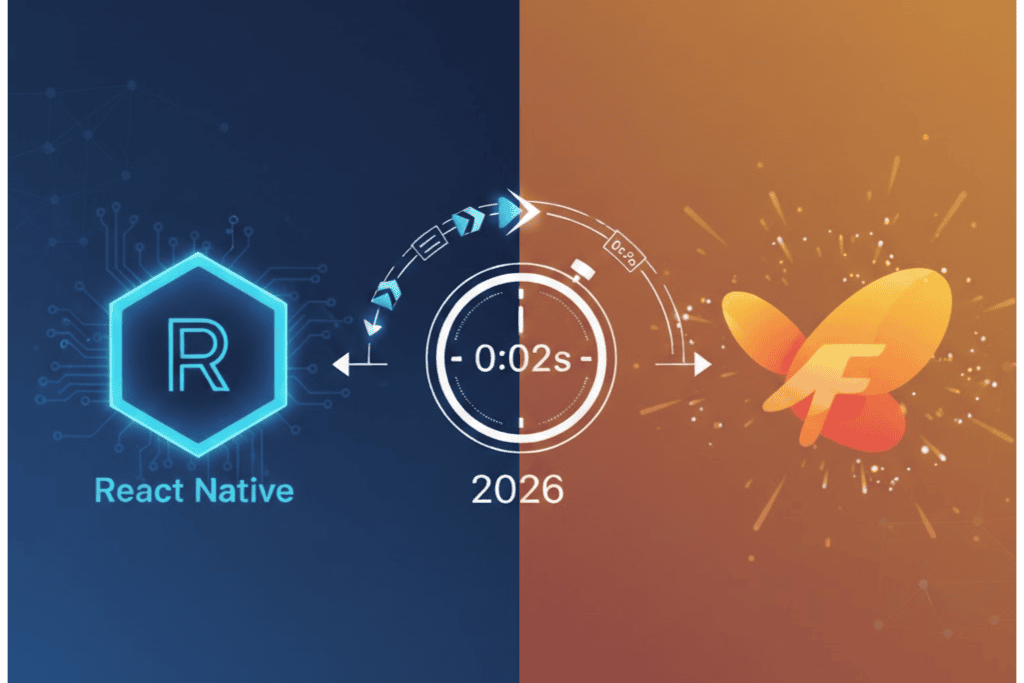
Even with advancements in devices and OS, mobile app start-up performance in 2026 continues to be one of the most important facets. It only takes 2-3 seconds to establish the app’s reliability and overall trust.
Cold starts, which occur when the app is not in memory, are the most detrimental to app performance. They directly correlate with user abandonment, session depth, and the new app store rankings, which consider performance. While warm starts and resume states are important, a slow cold start often overshadows everything else and shapes user expectations the most.
This paper does not aim to answer the question of ‘which framework is better.’ It analyzes React Native and Flutter through the lens of start-up performance and the architectural decisions pertaining to real products with start-up performance constraints typical of most modern start-ups.
What Start-Up Performance Actually Means
There is a common tendency to oversimplify start-up performance into a single metric. This is not reflective of reality, as it is a multi-faceted concept. These phases include:
- Cold start: This is when the app process is created, the runtime gets initialized, and the first frame is rendered.
- Warm start: This is when the app process is still in memory, but the UI needs to be reconstructed.
- Resumed state: This is when the app is returning from the background with minimal re-initialization.
There are additional costs associated with cross-platform frameworks:
- Pre-Flight Phase: Configure your respective JavaScript (React Native) or Dart (Flutter) environment.
- Engine Readiness: The Native rendering engine must be ready.
- Framework-specific Engineering: This involves the configuration of the bridge, registration of modules, or hierarchy of the renderer.
This Benchmark Delta is either from the standard from which the MinTime is derived, or it is considered
React Native Start-Up Performance in 2026
From 2023 to 2026, React Native experienced numerous changes that positively impacted its functionality throughout the increments. These include:
- Hermes: JavaScript is pre-compiled before being loaded, which prevents it from being parsed or evaluated.
Hermes usage can be verified at runtime:
const isHermes = () => !!global.HermesInternal;
For release builds, JavaScript compilation occurs during build time:
npm run android — –mode=”release”
Using non-standard bundle loading methods may bypass bytecode usage and should be validated through benchmarking.
- Fabric: assists in UI rendering due to its Architecture, frictionless coordination.
- TurboModules: prevents a lot of bridged modules from being loaded initially, and instead loads them at the start.
- Bridgeless Architecture: This eliminates the serialization costs associated with legacy bridges.
React Native startup performance depends on the application structure:
- Eager initialization of third-party libraries increases cold start latency
- Native modules may perform synchronous work on the main thread
- Performance improvements often require explicit deferral of non-critical logic
As a specialized React Native app development company, we focus on minimizing eager initialization to ensure lightning-fast cold starts.
How Hermes Improves App Launch Time
Hermes has the largest impact on React Native’s start-up improvements. It achieves this by pre-compiling its code to the binary format, which eliminates delays through runtime parsing and execution.
Less memory pressure when starting reduces the pressure for garbage collection at startup.
With large bundles compared to interpreted JavaScript engines, startup behavior is more predictable.
These optimizations are particularly beneficial for apps with lots of JS that runs at startup, according to Hermes documentation.
Considering React Native’s Strengths and Trade-Offs
There is no doubt that React Native’s start-up performance strengths exist, albeit with conditions.
- After optimizations, launch times improve.
- It is also influenced by third-party dependencies and how the app is initialized.
- A dependency-heavy app can still experience bad cold start performance if module loading is uncontrolled.
With React Native, the more flexibility you have for iteration speed, the more variability you introduce that teams must manage.
Flutter Start-Up Performance 2026
Engine-Level Control: the Core Advantage of Flutter
Flutter has a completely different take when it comes to start-up performance:
- For release builds, Dart is compiled ahead of time (AOT).
- There is no JavaScript runtime or bridge to start.
- Flutter doesn’t use the native UI components for rendering; it uses its own engine to do that.
The starting process is more streamlined: the engine boots, the Dart isolates, and it renders the first frame.
How the Impeller Improves Start-Up Consistency and Speed
By 2026, Impeller will be the default rendering backend on almost all platforms.
- Runtime shader compilation stalls are gone, thanks to precompiled shaders.
- Diminished rendering lag on the first frame.
- More consistent GPU pipeline across devices.
The aforementioned developments not only enhance average launch duration but also foster greater reliability, which is critical for improving perceived performance.
Realistic Strengths & Trade-offs
The start-up profile for Flutter is defined by:
- The cold start times are consistent across a variety of devices.
- Engine bundling results in slightly larger binary sizes.
- Less flexibility with respect to runtime deviances when compared with JavaScript-driven systems.
Having a more predictable performance profile means a more constrained opinionated runtime model with Flutter.
React Native vs Flutter Start-Up Performance (2026)
| Aspect | React Native | Flutter |
| Cold start consistency | Medium | High |
| Runtime initialization | JavaScript + native | Native engine only |
| First frame latency | Application-dependent | Deterministic |
| Tuning effort | Higher | Lower |
| Predictability at scale | Moderate | High |
Measuring performance in terms of startup duration is not the same as measuring it in terms of perceived startup time. Deferred logic, skeleton screens, and UX decisions can have more impact than the raw performance of the framework.
What This Means for Startups
Default performance levels that are acceptable with no optimization mean that Flutter is best for new teams. Additionally, when it comes to MVP iterations, runtime surprises are fewer. Finally, for smaller teams, framework guarantees are critical.
Scaling Products
At scale, React Native’s attractiveness comes into play:
Mature ecosystem and tooling.
Meaningful incremental performance gains.
JavaScript-based tools are the best starting point, even if they aren’t ideal, as they will inherently mesh best with the scalability of the framework.
Skill Level of Team Members & Hiring Reality
Dart-related hiring will be far more difficult than JavaScript.
Investing in optimizing a framework’s performance may be more expensive than simply using a framework with more sensible defaults, like Dart.
Most of the time, hiring challenges may outweigh the possible performance compromises.
Main Misconceptions Founders Should Be Aware Of
- Stating “React Native is slow by default” is mostly inaccurate because of the Hermes engine and the new architecture.
- “Flutter always starts faster” is true for most large applications, but it is less true as the application gets more sophisticated.
Believing that only the startup performance dictates the choice of framework is incorrect and is a strong oversimplification.
How Should CTOs Decide in 2026
Go for React Native if:
- You need to tap into the JavaScript ecosystem.
- The logic of your application is fluid.
- You see performance optimization as an ongoing engineering problem.
Choose Flutter if:
- You need consistent performance on startup.
- Your team is small and the speed of execution is pivotal.
- You prefer a smaller number of runtime dependencies.
Performance as an Outcome, Not as a Framework Attribute
By 2026, React Native and Flutter will become fully-fledged production frameworks. Start-up performance is no longer something developers inherit; they engineer it. The fastest apps are not built by simply choosing the ‘right’ framework. They are built by teams who optimize early, measure continuously, and consider performance a mandatory requirement instead of an afterthought.