




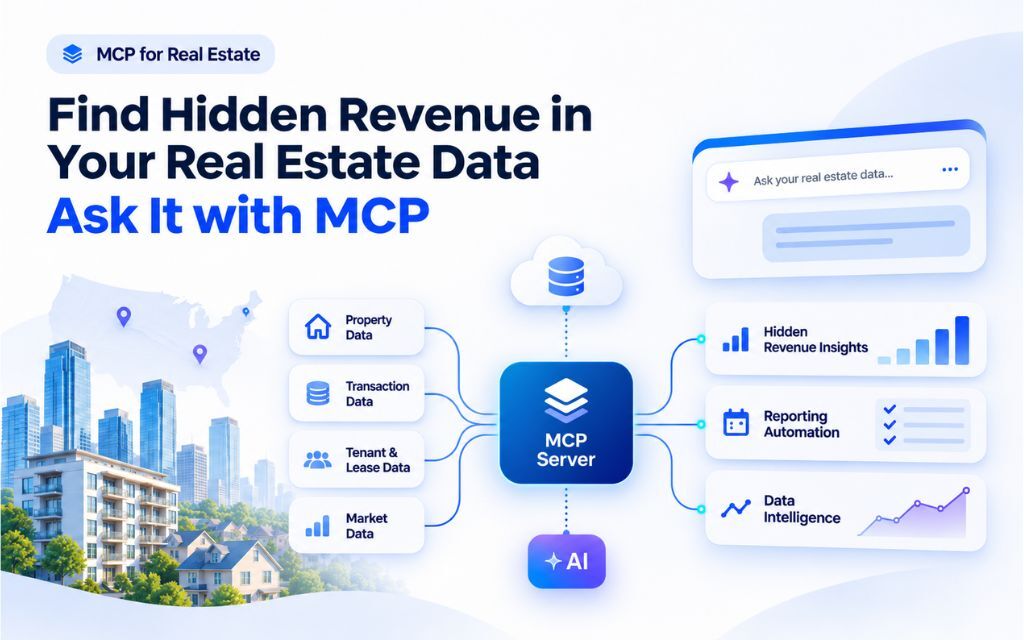
Your real estate data already knows where the money is. MCP lets you ask it.
One of our clients runs a real estate marketplace in the US. Buyers and sellers find agents through the platform, and the marketplace earns a fee when a deal closes. Some agents were closing deals with marketplace leads and never logging them, and the company had no practical way to find out which ones. Checking meant matching a year of lead activity against deal outcomes for more than 85,000 agents.
The data to answer that question was sitting in their own database the whole time. What was missing was a way to ask it.
We built them a custom MCP server, which lets ChatGPT, Claude or Gemini answer questions straight from the company’s data. Using it, the team traced unlogged sales from the past 12 months and recovered $200K in fees. The same setup now saves four people about two hours each every weekday on reporting, and the reports arrive early enough to act on the same day.
This post is for founders, CEOs, CTOs and technology leaders at US real estate companies who are wondering what MCP actually is, whether it is worth building, and how to do it without handing your client data to an AI model and hoping for the best. We will cover what an MCP server does, why real estate data is unusually hard to question, what we built for this client, where else it pays off, and what your CTO should insist on before anything touches production.
What an MCP server is, in plain terms
MCP stands for Model Context Protocol. Anthropic introduced it in November 2024 as an open standard for connecting AI assistants to outside tools and data. OpenAI adopted it in March 2025, Google DeepMind followed, and in December 2025 Anthropic handed the protocol to the Agentic AI Foundation under the Linux Foundation, which OpenAI and Block co-founded. In practical terms, it is no longer one company’s format. It is the way the major AI assistants expect to talk to business systems.
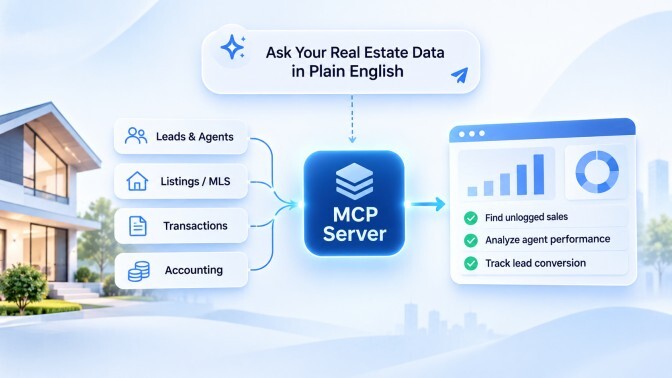
The simplest way to picture it: an MCP server is a translator and a gatekeeper that sits between an AI assistant and your data. On one side, the assistant asks a question in plain English. On the other side sit your CRM, your transaction database, your lead platform. The MCP server tells the assistant what data exists and what each piece means in your business, turns the request into a query your systems understand, checks that the request is allowed, and hands back the result.
Three things make this different from the AI tools most real estate companies have already tried.
First, the answers come from your live data. A chatbot pasted onto a spreadsheet export knows only what was in the export. An MCP server queries the source when you ask, so the answer reflects this morning’s leads, not last Tuesday’s.
Second, you are not locked into one AI vendor. Because MCP is a shared standard, the same server works with ChatGPT, Claude and Gemini. Your sales manager can use ChatGPT while your CFO prefers Claude, and both get the same numbers. If a better model arrives next year, you switch the assistant and keep the server.
Third, you decide what the AI can see. The server only exposes the tables, fields and actions you choose. It can be strictly read-only. It can hide personal contact details while still letting the assistant count them. That control is the difference between “we connected AI to our database” being a liability and being an asset.
One point of naming, because it confuses. People sometimes write “MVP server” when they mean MCP server. An MVP is a minimum viable product, the first working version of anything. You can certainly build an MCP server as an MVP, and we recommend starting small, but the protocol is MCP.
Why real estate data is so hard to question
Most real estate companies are not short of data. They are short of ways to ask it things.
A typical brokerage, marketplace or proptech platform runs on a patchwork. Leads arrive from the website, portals, ads and referrals. Agents work them in a CRM, or in their own phones, or both. Listings live in MLS feeds and an internal listing system. Transactions close in a separate transaction management tool, and the money shows up in accounting software weeks later. Each system has its own idea of what an “agent”, a “lead” or a “closed deal” is, and none of them were designed to be read together.
The result is a reporting process that depends on a few people. When a regional director wants to know which agents convert leads fastest in Phoenix, somebody has to know which tables hold what, write the query, clean the output and paste it into a spreadsheet. That person is usually also doing their actual job. So the report arrives the next day, or the next week, and by then the moment to act on it has passed.
This is exactly what our client was living with. Different teams needed different reports with different metrics, every day. Four people were spending about two hours each, every weekday, producing them. That is roughly 40 hours a week of skilled time spent on retrieving numbers rather than deciding what to do with them.
The deeper cost is the questions nobody asks. If every question costs an analyst half a day, people only ask the ones they are sure will pay off. Speculative questions, the “I wonder if” kind, never get asked. In our client’s case, the most valuable question of the year was one of those: which leads quietly turned into sales that never reached the books?
There is a second problem particular to commission businesses. Revenue depends on events that happen partly outside your system. An agent meets a buyer through your platform, then the conversation moves to text messages and a showing, and the closing happens through a title company you never hear from. Unless the agent logs it, your database sees a lead that went quiet. Finding the leads that went quiet for the wrong reasons means looking for patterns across thousands of records, which is precisely the work humans are slow at and machines are fast at.
What we built, and what it found
The project started with reporting. The revenue recovery depended on it, because once questions were cheap to ask, the hard one finally got asked.
We built a custom MCP server connected to the marketplace database. The work was less about the protocol itself, which is well documented, and more about teaching the server the client’s business. That meant mapping their vocabulary to their data: what counts as an active agent, which status means a lead is engaged, how a closed deal is recorded, which fields finance trusts and which ones nobody has updated since 2021. Every company has these rules, and they usually live in the heads of the people who write the reports. Writing them into the server is what lets an AI assistant give the same answer an experienced analyst would.
We then exposed a set of well-defined capabilities rather than raw database access. The assistant can look up agents, leads, listings and deals, filter and group them, and compare them across time and region. It cannot change records. Access is limited to the data the client approved.
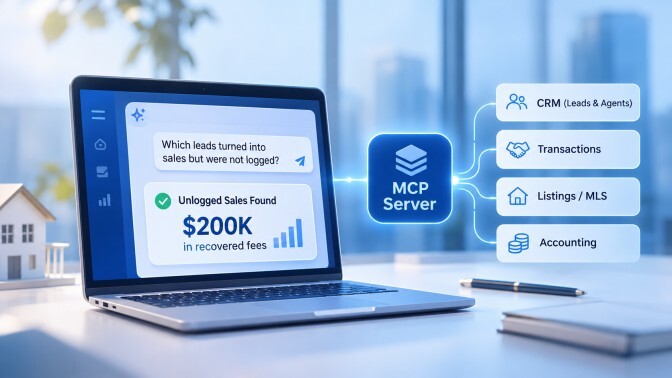
Once it was live, the team could type questions into ChatGPT, Claude or Gemini and get answers in seconds. The four people who had been building reports by hand got their two hours a day back, and managers started getting numbers early enough to act on them the same day.
Then the team turned to the question that had been out of reach. They asked for marketplace leads showing strong signs of a deal, where the agent had logged no closing. They narrowed the results by region, by agent, and by size, tested different definitions of a likely deal, and refined the list over a series of conversations. Each answer took seconds, which is what made the iteration practical. Doing the same work by hand across more than 85,000 agents and a year of activity would have taken an analyst weeks, if it was attempted at all.
The output was a list of agents who had made sales through the marketplace in the previous 12 months without recording them. The client followed up, and the fees recovered came to $200K.
| What changed | Before | After |
| Daily reporting | 4 people, 2 hours each, every weekday | About 40 hours a week freed |
| Turnaround | Reports often too late to act on the same day | Same-day action |
| Unlogged sales | Invisible | $200K recovered from the past 12 months |
| Who can ask questions | People who can write queries | Anyone with access to ChatGPT, Claude or Gemini |
The full write-up is in our case study.
[Confirm: the read-only setup, the data-dictionary work described above, and that the client followed up with each agent.]
Where an MCP server pays off in a real estate business
Lead leakage is the headline use case because it turns into cash quickly. It is far from the only one. These are the areas where we would expect the strongest return, depending on how your business makes money.
Lead leakage and referral fee recovery
Any business that earns on leads it hands out, whether a marketplace, a referral network or a team with a lead-sharing split, has some version of the problem our client had. The useful questions are about mismatches. Leads with heavy engagement and no outcome. Agents whose closing rate on your leads is far below their rate elsewhere. Buyers who went quiet on your platform shortly before a property they viewed was marked sold. None of these prove anything alone, but together they give your team a short, ranked list to follow up instead of a hunch.
Agent performance and coaching
Brokerage leaders spend a lot of time asking which agents need help and which deserve more leads. An MCP server lets a team lead ask “Who had more than 15 new leads last month and a response time over four hours?” in a sentence, then follow up with “Show me how that changed since June.” Coaching conversations get sharper when they start from the agent’s own numbers rather than a general impression.
Listing and inventory operations
Operations teams can track days on market, price reductions, stale listings and missing photos or documents across a portfolio without waiting for a weekly export. For property management companies, the same approach works for vacancies, maintenance tickets and lease renewals coming due.
Finance and reconciliation
Finance teams often run a monthly ritual of matching closed deals in the CRM against commission received in accounting. An MCP server connected to both can surface the gaps continuously. It can also answer the questions a CFO gets from the board without a two-day scramble.
Market and client reporting
Many brokerages send market updates to clients and investors. With the right data connected, an assistant can draft a neighborhood report from your own transaction history and listing data, which an agent then checks and sends. The value here is speed, and it only holds if a human reviews the result before it goes out.
The common thread is that each of these questions was always answerable in theory. The data existed. What changes is the cost of asking, which drops from hours of an analyst’s time to a sentence typed by whoever needs the answer.
For the CTO: architecture, security and governance
If you lead technology at a real estate company, your first reaction to “let’s connect AI to the database” should be caution, and it is a healthy one. MCP has grown faster than its security practices. In May 2026 the NSA observed that MCP’s rapid spread had outpaced the development of its security model, and researchers have documented real attacks, including hidden instructions planted in tool descriptions and a critical remote code execution flaw in a popular MCP proxy. A Cloud Security Alliance draft guide from 2026 catalogued roughly 7,000 MCP servers exposed to the internet, about half of them with no authentication at all.
None of this means you should stay away. It means a custom MCP server for your business data needs the same discipline as any other system that touches client records. These are the decisions we would expect any serious build to get right.
Expose capabilities, not the database
The weakest design hands the AI a general SQL tool and a database password. The stronger design defines a small set of specific tools, such as “find leads for an agent in a date range” or “summarize closings by office”, each with fixed parameters and a known query shape. The assistant can combine them freely, but it cannot invent a query you never approved. This also makes answers more consistent, because the business rules live in the tool, not in the model’s guess.
Read-only by default, least privilege always
Run the server under a dedicated service account that can only read the tables it needs. Use a read replica where you can, so heavy questions never slow down production. If you later add write actions, such as creating a follow-up task, give each one its own scope and require explicit human approval.
Protect personal data at the server, not in the prompt
Real estate data is full of names, phone numbers, emails and financial details. Mask or exclude fields the assistant does not need. It can count buyers in a ZIP code without ever seeing their names. Decide early which AI providers and plans are approved, and check their data retention terms, because the query results do pass through the model.
Authenticate every user and log every call
For a remote server, use OAuth 2.1, which the MCP specification now requires, and tie each request to a named user with role-based permissions, so a regional manager sees only their region. Log every tool call with the user, the tool, the parameters and the time. The CSA guidance suggests keeping those logs for at least 90 days and watching them for unusual patterns.
Treat outside content as untrusted
Prompt injection is the risk most specific to AI systems. If any text the assistant reads, such as a lead’s notes or a listing description, can contain instructions, the model may follow them. Keep your server’s tools narrow, never let retrieved text trigger actions on its own, pin the versions of any third-party MCP components, and review tool descriptions when they change.
A well-built server is often easier to audit than the current reality, where analysts export sensitive data into spreadsheets that end up in email threads and personal drives.
How to start: a pilot, not a platform
The fastest way to waste money on AI is to start with a grand data strategy. The fastest way to prove value is to pick one expensive question and answer it.
We recommend a pilot in four steps.
Start by picking one painful report or one money question. The best candidates are reports someone builds by hand every day or week, or a question leadership has wanted answered for months. Lead leakage, agent conversion by source and commission reconciliation are good first choices.
Then connect one data source, read-only. Usually that is the main operational database or CRM. Map the business terms for that domain only, and define a handful of tools around the pilot question.
Put it in front of the people who build the report today. They know the edge cases, and they will tell you within a day whether the answers match what they would have produced. Their trust decides whether anyone else uses it.
Finally, measure it plainly: hours saved per week, how quickly reports reach the people who act on them, and any revenue found or protected. In our client’s case those numbers were about 40 hours a week, same-day action and $200K.
If the pilot works, extend it one source and one team at a time. Most of the long-term value comes from the second and third data sources, because the most useful questions cross systems, such as CRM activity against accounting receipts.
What it costs
Cost depends mostly on how messy the data is and how many systems you connect, not on the protocol. A focused pilot on one clean database is a small project measured in weeks. Connecting several systems with inconsistent definitions, adding role-based access and meeting a security review takes longer. Running costs are modest: the server itself is lightweight, and the main ongoing expense is the AI assistant subscriptions your team already pays for or will add. [Insert AvyaTech’s typical pilot price range and timeline.]
Build or buy
Some CRMs and real estate platforms offer their own AI assistants or connectors, and more are adding them. If all your data lives in one such product, try its built-in option first. A custom server earns its place when your data is spread across several systems, when your business rules are specific to you, or when you want control over which AI providers see what.
Where MCP is not the answer
An MCP server makes good data easy to question. It does not make bad data good. If agents rarely update lead status, if the same deal sits in three systems with three prices, or if nobody agrees what “closed” means, an AI assistant will answer quickly and confidently from that mess. Sometimes the first useful outcome of a pilot is a list of data problems to fix.
It is also the wrong tool for numbers that must be exactly the same every time and go to regulators, lenders or auditors. Keep those in your reporting system with fixed definitions. The assistant is for exploration, daily operations and finding the questions worth formalizing.
And it does not replace judgment. The $200K came from people following up on a list, checking each case and having the conversations. The server found the list. Humans decided what it meant.
Find out what your data already knows
AvyaTech builds custom MCP servers for real estate companies that want answers from their own data without giving up control of it. We start with one question that matters to your business, connect only what it needs, and measure the result in hours and dollars.
If your team spends hours every week building reports, or you have a question you suspect would be worth money if someone could answer it, book a 30 minute call. Bring the question. We will tell you honestly whether an MCP server is the right way to answer it.
Book a discovery call or read the full case study.
Frequently asked questions
An MCP server is a service that connects AI assistants such as ChatGPT, Claude and Gemini to your business systems using the Model Context Protocol, an open standard. It tells the assistant what data and actions are available, runs approved queries and returns the results.
No. MCP is the Model Context Protocol. An MVP is a minimum viable product. A first MCP server is often built as an MVP, which is why the two get mixed up.
The results of each question pass through the AI model you use, so choose approved providers and plans with suitable data terms. The server controls what is exposed, so you can mask or exclude personal details the assistant doesn’t need.
Only if you build tools that allow it. We recommend read-only access to start, and any write action later should have its own permission and human approval.
Anything with a database or an API: CRMs, transaction management tools, listing systems, MLS feeds you are licensed to use, accounting software and data warehouses.
A focused pilot on one data source usually takes a few weeks. Timelines grow with the number of systems and the state of the data.